
- All
- Product Name
- Product Keyword
- Product Model
- Product Summary
- Product Description
- Multi Field Search

Views: 0 Author: Site Editor Publish Time: 2026-10-22 Origin: Site


Yes, but attempting to do so with standard shop machines usually results in fatal equipment failure. Because concentrated oxygen reacts violently with trace hydrocarbons and adiabatic heat, specialized purpose-built equipment is an absolute necessity.
Imagine your facility needs to store life-saving breathable gas or fuel a heavy-duty industrial cutting torch. In these high-stakes operational scenarios, standard air-pumping equipment becomes a severe liability. As field engineers frequently witness, ignoring the volatile nature of oxidizers leads to catastrophic structural failures. In this technical guide, you will dive into the exact thermodynamics behind gas pressurization, uncover why standard systems fail, and learn how purpose-built dry-lubrication technology safely solves this complex engineering challenge.
Recent supply chain volatility has drastically reshaped the global industrial and medical gas landscape. Historically, facilities relied heavily on delivered bulk liquid oxygen. Today, there is a massive macro trend toward decentralized, on-site gas generation. Facilities are pairing Pressure Swing Adsorption plants with dedicated compression equipment to achieve total gas autonomy.
This shift eliminates exorbitant delivery fees, hazardous material handling surcharges, and the inevitable product loss caused by cryogenic boil-off. Consequently, the demand for robust, autonomous compression technology has surged, driving innovations in low-speed, high-efficiency mechanical designs that allow independent plants to produce and store their own supply securely.
From a strict thermodynamics standpoint, the gas behaves much like ambient air. Following Boyle’s Law, the pressure of an ideal gas increases as its physical volume decreases, assuming temperature remains constant. In practical field terms, forcing the same mass of gas into a smaller steel cylinder inevitably spikes the internal pressure. Therefore, the gas is entirely compressible.
However, engineers must clearly distinguish between compressed gaseous states and cryogenic liquids. Pressurizing the gas simply packs the molecules into a highly dense state for efficient high-pressure storage. Turning it into a liquid cannot be achieved through mechanical compression alone at standard room temperatures. It requires extreme cryogenic cooling below -183 degrees Celsius. For the vast majority of industrial and medical applications, facilities rely entirely on compressing the gas rather than managing volatile cryogenic liquids.
While the fundamental mechanics of a piston stroke are identical to pumping ambient air, the chemical reality inside the cylinder is vastly different. The gas itself is not flammable, but it is a profoundly powerful oxidizer. It aggressively accelerates the combustion of nearly any organic material.
To fully grasp the severe danger, field technicians look at the classic Fire Triangle, which dictates that combustion requires an oxidizer, fuel, and heat.
When these three elements combine inside a standard cast-iron cylinder, the highly concentrated oxidizer instantly ignites the lubricating oil. This triggers catastrophic fires and explosive structural failures. This unique danger is exactly why specialized, hydrocarbon-free equipment remains strictly regulated by global safety agencies.
Hydrocarbons, including the mineral or synthetic oils traditionally used to lubricate mechanical crankshafts and pistons, are exceptionally dangerous when exposed to high-pressure oxidizers. Under normal atmospheric conditions, oil requires a direct spark or extreme ambient heat to ignite. In an oxygen-enriched, high-pressure environment, the ignition temperature of these oils drops drastically.
Even a microscopic droplet of residual grease can undergo rapid oxidation. This localized chemical reaction generates additional heat, instantly triggering a chain reaction that vaporizes and ignites the remaining lubricants. Industry professionals refer to this violent phenomenon as dieseling. To mitigate this fatal risk, engineering safety protocols strictly mandate the complete exclusion of all hydrocarbons from the wetted parts of the system.
To overcome the lubrication hurdle without compromising safety, engineers utilize the oil free oxygen compressor. Instead of relying on fluid lubricants to reduce metal-on-metal friction, these advanced machines deploy self-lubricating dry materials alongside highly specialized cooling architectures.
The internal piston rings, guide bands, and packing seals are typically manufactured from Polytetrafluoroethylene, widely known in the industry as PTFE or Teflon. To enhance mechanical durability under extreme pressure, these compounds are reinforced with carbon, bronze, or glass fibers. PTFE boasts one of the lowest coefficients of friction of any known solid material and is entirely chemically inert. It simply will not react or combust when exposed to concentrated oxidizers.
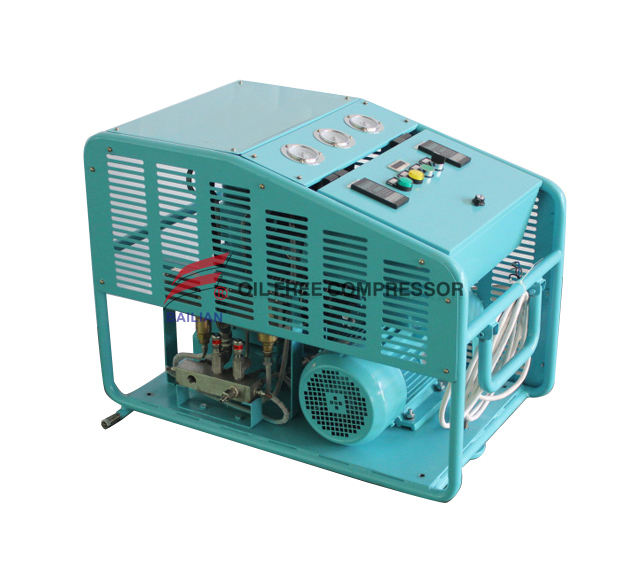
At its core, this equipment is a purpose-built mechanical device designed to take low-pressure gas, usually generated by an on-site generator or a liquid tank vaporizer, and exponentially increase its pressure to a usable level.
The most proven design for this application is the reciprocating piston architecture. The mechanical process follows a precise, continuous cycle. First, the piston moves downward, creating a mechanical vacuum that draws low-pressure gas into the chamber through a precision inlet valve. Next, the inlet valve snaps shut, and the piston reverses direction. This upward stroke dramatically decreases the cylinder volume, forcing the molecules tighter together and spiking the internal pressure. Finally, once the target pressure threshold is achieved, the discharge valve opens, pushing the pressurized gas into the cooling system.
For high-pressure applications, engineers never attempt to achieve maximum pressure in a single stroke. Compressing gas too aggressively generates uncontrollable adiabatic heat. Premium industrial models feature multi-stage compression, often utilizing up to four distinct cylinders. By breaking the workload into stages, the equipment manages thermal output safely.
Thermal management dictates the lifespan of the machine. Inter-stage cooling is deployed between every single compression stage. After the gas exits the first cylinder, it routes through a robust heat exchanger to strip away the heat before entering the subsequent cylinder. Furthermore, top-tier machines operate at remarkably low speeds, often around 400 RPM, to minimize friction heat and significantly extend the lifespan of the PTFE consumable rings.
Equally vital are the sealing mechanisms. Leaks represent severe safety hazards, potentially creating enriched atmospheres in the equipment room. Compressors utilize rigorous labyrinth seals, extended distance pieces, and specialized packing boxes to physically isolate the compression cylinders from the mechanical crankcase. This guarantees no gas escapes into the ambient environment and no external airborne contaminants enter the pure gas stream.
In the healthcare sector, equipment reliability and absolute gas purity are quite literally matters of life and death. A purpose-built medical oxygen compressor is specifically engineered to meet strict regulatory standards. These specialized units pressurize gas generated by on-site plants, distributing it seamlessly through a hospital's central copper piping network to patient ventilators. They prioritize ultra-quiet operation, continuous reliability, and strict adherence to cleanliness protocols.
A booster serves a highly distinct operational purpose. Rather than drawing from an ambient or low-pressure source, an oxygen booster compressor takes gas that is already pressurized and elevates it to an extreme level. These units are essential for blending breathing gases for deep technical SCUBA diving or filling emergency cylinders for aerospace applications. They are compact, highly efficient, and capable of taking a standard inlet pressure and safely elevating it well past 200 bar.
Heavy industrial applications require rugged, high-volume solutions. For independent facilities aiming to eliminate reliance on third-party gas deliveries, installing an oxygen cylinder filling compressor is the ultimate logistical upgrade. These heavy-duty machines often sustain outputs between 150 bar and 200 bar. For example, a standard 2 cubic meter per hour unit utilizing a 4-stage compression design can continuously fill standard steel cylinders safely. They feature robust cast-iron frames, water-cooling jackets, and advanced telemetry sensors to monitor vibration and temperature in real-time.
| Equipment Type | Typical Pressure Range | Cooling Architecture | Primary Application |
|---|---|---|---|
| Medical Pipeline Unit | 4 to 10 Bar | Air-Cooled | Hospital ventilator supply networks |
| Industrial Booster | Up to 200 Bar | Air or Water-Cooled | Aerospace, technical diving gas blending |
| Cylinder Filling Station | 150 to 200 Bar | Multi-Stage Water-Cooled | On-site commercial gas packaging |
The most critical safety protocol happens long before the machine reaches your facility. Because the gas is intensely reactive, every single internal component touching the gas stream must undergo rigorous oxygen cleaning. Technicians meticulously scrub the wetted parts to remove all trace hydrocarbons, manufacturing dust, and microscopic particulate matter.
This exhaustive process involves washing parts with specialized non-combustible solvents, followed by inspection under ultraviolet light to detect lingering organic residue. Even a stray fingerprint left by a careless technician contains enough human oil to cause a localized ignition under pressure. Reputable manufacturers assemble these machines in certified cleanrooms to maintain this flawless safety standard.
Operating equipment that handles highly oxidizing gases requires unwavering adherence to facility safety protocols. Field engineers always prioritize thermal monitoring. You must ensure the inter-stage and final discharge temperature sensors remain fully functional. Unexplained high heat is the very first indicator of failing PTFE rings.
Furthermore, ensure maximum room ventilation. The equipment room must have powerful, continuous airflow. If a minor seal leak occurs, proper ventilation prevents the room from becoming a dangerous oxygen-enriched environment. Conduct proactive maintenance by replacing consumable parts exactly according to the manufacturer's hour-meter guidelines. Never wait for a component to fail before servicing it, and never bypass high-temperature automatic shutdown switches.
Selecting the correct equipment is a critical engineering and financial decision. Standard procurement protocols for everyday shop air machines simply do not apply here. Lead engineers must evaluate equipment based on precise volumetric requirements, thermal tolerance, and long-term operational costs.
The fundamental metrics for sizing any system are the volumetric flow rate and the final discharge pressure. Flow rate dictates exactly how much gas the machine processes within a given timeframe, typically measured in Normal Cubic Meters per Hour. When sizing the system, calculate your absolute peak consumption rather than a daily average. If your facility relies on a generator plant, the compressor’s intake capacity must perfectly match the generator's output to prevent system back-pressure.
Pressure requirements vary drastically depending on the end-use application. Low to medium pressure systems, operating between 4 and 10 bar, are standard for hospital pipeline networks. Conversely, high-pressure industrial applications require robust multi-stage systems capable of safely achieving 150 to 200 bar for standard steel cylinder storage.
When investing in advanced gas technology, the initial purchase price represents only a fraction of the financial equation. Organizations must calculate the Total Cost of Ownership over a standard operational lifecycle. Transitioning to an on-site generator paired with a dedicated compressor completely severs expensive liquid delivery dependencies. The return on investment typically ranges from 12 to 24 months, depending on local electricity rates.
Because these systems rely on specialized self-lubricating materials for piston rings, these are considered consumable parts. Evaluate the operational speed of the machine. A premium low-speed compressor operating at 400 RPM will experience significantly less friction wear than a cheaper, high-speed alternative, drastically reducing your annual maintenance labor and replacement part costs.
Pressurizing oxidizers safely requires highly specialized, meticulously engineered machinery. Attempting to cut corners with standard shop equipment is a guaranteed recipe for catastrophic failure. An oil-free, dry-lubricated system is the only scientifically sound method to ensure pure gas output and absolute facility safety.
Selecting the exact model for your operation depends heavily on your specific flow rate and pressure requirements. By carefully evaluating these metrics, your facility can transition to a highly efficient, autonomous gas supply. Always prioritize safety, demand strict industry compliance, and partner with an expert engineering team to guide your procurement process. For precision-engineered solutions tailored to your operational needs, explore the advanced technology available at oxygen-compressors.com.
No, compressing the gas at room temperature will never turn it into a liquid, regardless of how much mechanical pressure is applied. Every gas has a critical temperature above which it cannot be liquefied by pressure alone. The critical temperature of this element is extremely low at -118.6 degrees Celsius. Because standard room temperature is far above this threshold, the compressor merely packs gaseous molecules into a smaller volume. Producing cryogenic liquid requires complex air separation units that drop temperatures below -183 degrees Celsius.
Using a standard machine is virtually guaranteed to cause an explosion. Standard machines rely on petroleum-based lubricating oils to reduce internal friction. In a normal atmospheric environment containing 21 percent oxygen, these materials are stable. However, in a highly concentrated pure environment, these oils become highly reactive fuels. When combined with the intense adiabatic heat generated during the piston stroke, the oil auto-ignites instantly, resulting in a violent structural failure.
The maximum achievable pressure depends entirely on the design architecture and the number of compression stages utilized. For standard industrial and medical cylinder filling operations, a multi-stage piston compressor safely achieves pressures ranging from 150 bar to 200 bar. For specialized aerospace testing, engineers utilize diaphragm compressors, which can safely push pressures up to 300 bar or higher, provided strict blast-proof safety protocols are in place.
The lifespan is viewed in two distinct categories: the structural lifespan of the core machinery and the operational lifespan of the consumable wear parts. The core structural components, such as the cast iron crankcase and electric motor, are built for heavy-duty endurance and can easily last 15 to 20 years with proper maintenance. The dry-lubrication consumable parts, like PTFE piston rings, are designed to slowly wear away. Depending on the operating pressure and the machine's RPM, these Teflon components typically require replacement every 2,000 to 4,000 hours of operation.
Pricing varies significantly based on the required flow rate, maximum discharge pressure, and cooling architecture. A small, low-pressure medical booster may cost a few thousand dollars, while a heavy-duty, multi-stage industrial cylinder filling station capable of high volumetric flow can range from $15,000 to over $50,000. When budgeting, facilities must factor in the Total Cost of Ownership, as high-efficiency, low-RPM models cost more upfront but save thousands in maintenance and electricity over their lifecycle.
These are two entirely different pieces of equipment that perform complementary functions. A concentrator, or generator, separates ambient air to produce high-purity oxygen gas, but it typically outputs this gas at a very low pressure. The compressor is the mechanical device placed downstream from the concentrator. It takes that low-pressure pure gas and squeezes it into a high-pressure state, allowing it to be stored in steel cylinders or pushed through extensive facility piping networks.