
- All
- Product Name
- Product Keyword
- Product Model
- Product Summary
- Product Description
- Multi Field Search

Views: 0 Author: Site Editor Publish Time: 2026-08-10 Origin: Site


Helium presents unique operational challenges across modern industrial environments. Its exceptionally low molecular weight and high market scarcity make system inefficiencies financially punitive. If you lose gas, you lose critical resources. Mismatching your equipment capacity directly leads to severe energy waste, dangerous thermal stress, process bottlenecks, or excessive gas leakage. You simply cannot afford to guess when sizing this infrastructure. We will explore how to build a robust technical framework for evaluating your specific process demand. You will learn to select optimal capacity modulation strategies tailored to your facility operations. Finally, we will help you shortlist the appropriate mechanical architecture for high-stakes industrial applications. By applying these methods, you can ensure reliable, stable, and highly efficient helium management.
You must establish clear success criteria before evaluating any equipment. Process stability dictates how well your production line operates. Gas conservation metrics reveal your system containment efficiency. Energy usage determines your ongoing operational footprint. We evaluate these three pillars to define your operational baseline.
Dynamic profiling requires precise data collection. You must measure mass flow rates during steady-state operations. You also need to record transient peak demands. We typically follow a structured approach to capture this data:
Accurate measurement prevents catastrophic system failures. Common mistakes include relying solely on theoretical pipe calculations instead of actual flow meter data.
Different facilities demand drastically different duty cycles. Semiconductor manufacturing environments usually require continuous operation. They demand unwavering pressure stability over long periods. Intermittent batch processing presents a different challenge. It creates extreme peaks followed by extended idle times.
You must carefully assess the impact of oversizing your equipment. An oversized unit leads to frequent cycling wear. It causes premature valve failure and motor fatigue. Conversely, undersizing starves your process. It triggers low-pressure alarms and halts production lines. Proper duty cycle analysis ensures your equipment runs within its optimal efficiency band.
Demand rarely remains perfectly flat. You need active modulation strategies to adjust output dynamically. These methods protect the equipment while maintaining strict process parameters.
VFDs provide the most elegant capacity control. They adjust the motor RPM to match volumetric output linearly to your real-time process demand. The mechanism relies on advanced inverter technology.
This approach significantly reduces mechanical wear on internal components. It lowers energy consumption by eliminating wasteful un-loaded running time. It also maintains highly precise pressure control during variable loads. When demand drops, the motor simply slows down. This creates a highly responsive gas management loop.
Some processes generate instant demand spikes. A standalone machine cannot accelerate fast enough to meet these surges. You must decouple the output from immediate process spikes. Intermediate high-pressure receivers serve this exact purpose.
Integration often requires a high pressure helium booster to efficiently charge storage cylinders during off-peak periods. The system pushes gas into buffer tanks when plant demand is low. It readies the system for sudden demand surges. This pressure cascading smooths out erratic load profiles effectively.
Bypass control offers a simpler, mechanical modulation method. The system routes excess compressed gas back to the suction inlet. It keeps the machine running at constant speed while shedding excess volume.
However, this strategy introduces severe thermal risks. Recirculating gas rapidly elevates the heat of compression. You must implement rigorous thermal management protocols. Unchecked recirculation quickly leads to catastrophic overheating. Best practices dictate using bypass loops only for short durations or emergency stabilization.
Your chosen modulation strategy must match the underlying mechanical architecture. Different designs respond differently to variable loads. We must evaluate these limitations carefully.
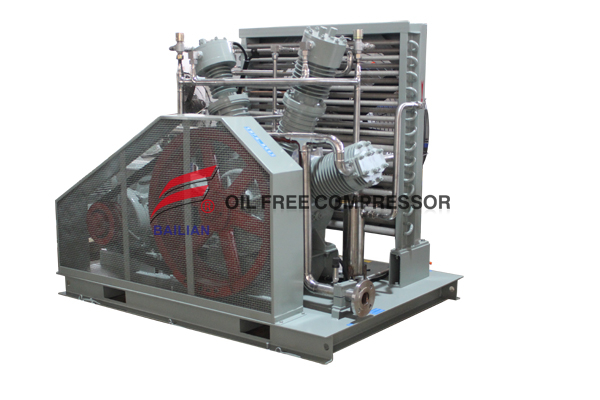
Contamination-sensitive applications mandate strictly controlled environments. Medical MRI magnet cooling and aerospace testing facilities cannot tolerate hydrocarbon carryover. In these scenarios, an oil free helium compressor is absolutely necessary. Diaphragm or specialized dry piston designs handle variable loads without risking oil migration. They rely on advanced materials rather than fluid films for sealing.
Conversely, oil-flooded or lubricated systems suit closed-loop industrial refrigeration. They prioritize bulk gas movement. Heavy filtration handles trace oil removal. These systems often tolerate rapid cycling better due to internal fluid cooling.
Volumetric efficiency changes across different load profiles and pressure ratios. As pressure increases, internal slip reduces output. You must rely on transparent vendor performance curves rather than theoretical maximums.
| Load Profile | Recommended Architecture | Primary Modulation Method | Key Process Advantage |
|---|---|---|---|
| Steady, Continuous | Lubricated Screw | VFD (Narrow Band) | High volumetric efficiency and stable thermal control. |
| Highly Variable, Clean | Dry Piston / Diaphragm | VFD (Wide Band) | Absolute zero contamination during low-speed operation. |
| Intermittent Peak Spikes | Hybrid Storage System | Buffer Cascading | Decouples mechanical operation from instantaneous process surges. |
This data reveals why aligning internal mechanics with external process demands prevents premature system failure.
Even perfectly sized systems face operational hurdles. The physical properties of the gas make containment and cooling exceptionally difficult under varying loads. We must address these inherent difficulties proactively.
Frequent load and unload cycling stresses static and dynamic seals. The constant pressure fluctuations cause microscopic shifting in gasket materials. A properly specified Helium Compressor requires advanced containment engineering.
You must demand evidence of verifiable leak-tightness. Standard pressure decay tests are insufficient. Require helium mass spectrometer testing at both peak and minimum operating loads. This rigorous validation ensures seals remain seated properly regardless of the capacity modulation state.
Running at partial loads or high pressure ratios drastically alters the thermal dynamics. When gas volume drops, there is less mass to carry away internal heat. You run severe risks of overheating.
Evaluate your cooling requirements based on the facility ambient conditions. Water-cooled designs offer superior heat rejection for heavy-duty cycling. Air-cooled configurations work well for smaller capacities but struggle during sustained bypass operations. Your selected modulation strategy directly dictates your cooling infrastructure.
Your existing piping network plays a crucial role in capacity matching. Assess the internal volume of the plant piping. A large-diameter network often acts as an adequate buffer for minor demand fluctuations.
However, short pipe runs offer zero buffering capacity. In these cases, dedicated storage vessels are explicitly required. Proper infrastructure integration smooths out demand fluctuations before they reach the main intake valves.
Selecting the right equipment goes beyond reading specification sheets. You must evaluate the vendor ecosystem and the control integration capabilities. A poorly integrated helium compressor creates isolated automation islands.
Never treat these systems as generic utilities. You should require documented case studies from the manufacturer. Demand reference installations located in your specific industry. A vendor supplying breathing gas systems may not understand the stringent purity requirements of semiconductor fabrication.
Examine their engineering support structure. Do they understand atmospheric gas recovery? Can they provide custom performance curves for your exact gas composition? Vendor expertise separates successful deployments from chronic operational failures.
Modern capacity modulation relies entirely on robust automation. Ensure the local Programmable Logic Controller (PLC) integrates seamlessly with your plant-wide Distributed Control System (DCS) or SCADA network.
You need automated, real-time demand matching. The local PLC must read downstream pressure transmitters instantaneously. It should flag anomaly detection parameters before mechanical failure occurs. Open communication protocols allow your central control room to trend performance data, adjust VFD parameters remotely, and monitor critical thermal limits.
Matching capacity requires a holistic, systems-level approach. It is not just about sizing a pump. You are designing an integrated, highly sensitive gas management system. Balancing flow rates, pressure ratios, and thermal loads dictates the long-term viability of your recovery or processing loop.
We encourage you to compile your dynamic load data meticulously. Gather continuous baseline metrics and peak surge volumes. Ask shortlisted vendors for custom performance simulations based on this data prior to procurement. Taking these definitive steps ensures your infrastructure operates safely, efficiently, and reliably for years to come.
A: Oil-free designs typically utilize VFDs or precise bypass controls to match flow. This ensures seal integrity and thermal limits are maintained tightly. They do not rely on fluid lubrication for internal cooling, allowing safe operation at low speeds without risking harmful carryover into the process stream.
A: Boosters are essential when the process experiences sharp, high-volume peak demands that exceed primary continuous output. They charge high-pressure buffer storage cylinders during off-peak times. This cascading setup releases large volumes instantly, satisfying sudden process surges without requiring an oversized primary unit.
A: Excessive use of bypass valves is the primary culprit. This method wastes massive amounts of energy by constantly recompressing the exact same gas. It also creates unmanaged heat of compression. Using Variable Speed Drives offers a far more efficient alternative for accurate demand matching.