
- All
- Product Name
- Product Keyword
- Product Model
- Product Summary
- Product Description
- Multi Field Search

Views: 0 Author: Site Editor Publish Time: 2026-08-08 Origin: Site


Compressing nitrogen to high pressures generates exponential adiabatic heat. This heat directly threatens equipment integrity and operational returns if left unmanaged. Interstage cooling solves this fundamental challenge. For plant managers and lead engineers, the efficiency of a High Pressure Nitrogen Compressor relies entirely on how effectively heat is removed between compression stages. Without optimal heat extraction, the system consumes excessive power and experiences accelerated wear.
This guide breaks down interstage cooling architectures. We will evaluate specific criteria and implementation risks. Buyers can use these insights to specify the right thermal management system for their facility. You will learn the mechanics behind air-cooled and water-cooled systems. We also explore the strict tolerances required for specialized boosters. You can then align these thermal strategies against your specific operational demands.
Unmanaged compression heat harms volumetric efficiency. Hot gas expands rapidly inside the cylinder. This expansion fills the cylinder cavity prematurely. You must expend more power to move the identical gas mass. OPEX climbs rapidly under these conditions. Intercooling removes this excess thermal energy between stages. Cooled nitrogen becomes denser. The subsequent compression stage can then ingest a larger mass of gas per stroke. This density correction directly reduces the specific electrical work required. Plant operators see immediate energy savings. Ignoring this thermodynamic reality guarantees poor energy performance.
Excessive interstage temperatures destroy internal components. Nitrogen compression often reaches extreme temperatures during high-ratio stages. These temperatures degrade vital moving parts. Valves warp under continuous thermal stress. Piston rings lose their sealing properties. Packing cases fail prematurely. Thermal degradation leads to internal gas leaks. These leaks force the machine to recompress the same gas repeatedly. This compounding failure loop accelerates total mechanical breakdown. Proper intercooling keeps discharge temperatures well below component failure thresholds. Most industry standards cap discharge temperatures around 300°F (149°C) to ensure hardware longevity.
Thermal control extends beyond the compressor block. Consistent gas cooling is mandatory before routing to a nitrogen gas storage compressor. High-pressure storage vessels suffer from thermal expansion stresses if they receive abnormally hot gas. Metal fatigue accumulates over hundreds of fill cycles. Cold gas ensures stable storage pressures. It prevents sudden pressure drops inside the vessel as the gas naturally cools later. Engineering teams must prioritize thermal stability to protect downstream piping networks and storage arrays.
Air-cooled systems rely on ambient air flow. Forced draft fans push air across finned tube bundles. The hot nitrogen flows inside these tubes. Heat dissipates into the surrounding atmosphere.
Best for: Remote locations heavily favor this architecture. Facilities lacking cooling water infrastructure rely entirely on air cooling. Operators deploying mobile skids use them frequently. They serve lower-duty cycles exceptionally well.
Limitations: Performance remains highly dependent on ambient environmental temperatures. Extreme summer heat drastically reduces cooling capacity. The system struggles to achieve tight approach temperatures during heatwaves. High-flow applications demand massive fan assemblies. This requirement creates a significantly larger physical footprint on the plant floor.
Water-cooled units use liquid as the primary heat sink. Nitrogen flows through tubes while water circulates around them. The liquid absorbs and carries away the thermal energy.
Best for: Continuous heavy-duty cycles demand liquid cooling. Ultra-high-pressure applications generate too much heat for air fans. Base-load chemical plants mandate this architecture.
Advantages: Water provides superior heat transfer rates. It maintains stable performance regardless of ambient plant temperatures. Operators achieve much tighter approach temperatures. The physical footprint remains compact even at massive gas flow rates.
Requirements: This setup requires dedicated facility cooling water loops. You must install cooling towers or chillers. Proactive water quality management becomes mandatory to prevent internal degradation.
| Feature | Air-Cooled Systems | Water-Cooled Systems |
|---|---|---|
| Heat Sink Medium | Ambient Air | Treated Cooling Water |
| Footprint | Large (requires space for fans and fins) | Compact (high heat transfer density) |
| Ambient Dependence | High (struggles in summer months) | Low (stable year-round performance) |
| Infrastructure Need | Electrical power for fans | Cooling towers, pumps, water treatment |
| Maintenance Focus | Fin cleaning, fan motor lubrication | Tube descaling, fluid chemistry testing |
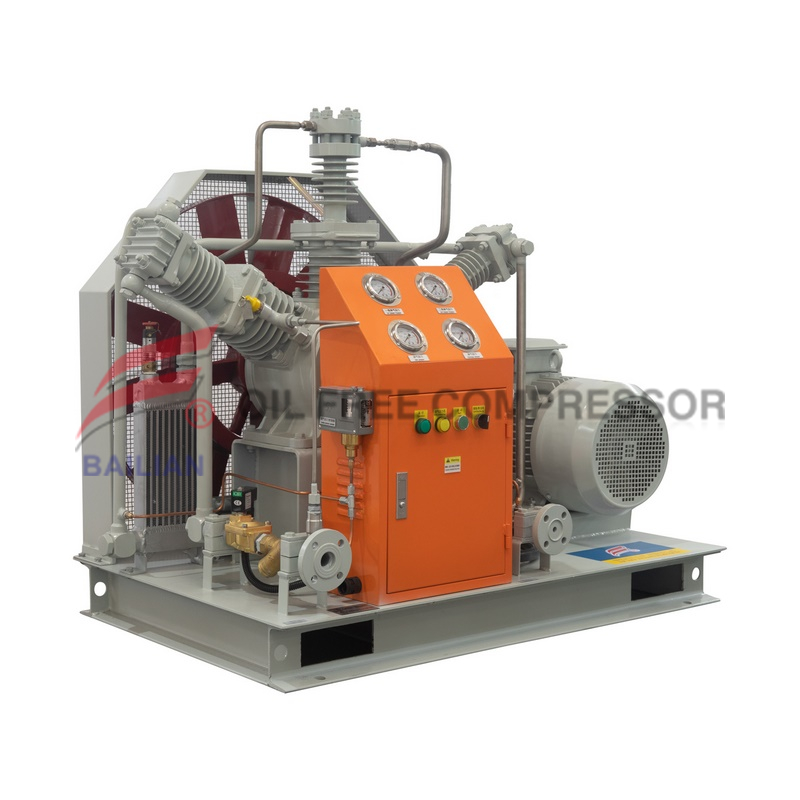
Oil-lubricated compressors possess an inherent thermal advantage. The crankcase oil acts as a secondary heat sink. It splashes onto cylinder walls and absorbs excess energy. Conversely, an oil free nitrogen booster lacks this internal fluid entirely. There is no oil to carry away internal cylinder heat. The machine relies entirely on external jacket cooling and intercoolers. This design shift places massive operational burden on the external heat exchangers. If the intercooler underperforms, the next cylinder stage rapidly overheats. The margin for thermal error shrinks to near zero.
Dry-running components exhibit extreme sensitivity to heat. Engineers utilize PTFE (Polytetrafluoroethylene) and specialized composite blends for piston rings. Guide bands share this same metallurgy. These materials provide self-lubrication. However, they possess strict maximum temperature thresholds. Most non-lube materials begin to lose structural integrity above 350°F (176°C). Overheating causes rapid deformation. The rings extrude into the clearance spaces. Seal failure follows immediately. Metal-to-metal contact occurs once the guide bands melt. This catastrophic progression destroys the entire cylinder assembly.
Decision makers must scrutinize vendor proposals closely. Buyers must verify cooler sizing methodologies. Follow this specific evaluation logic:
Taking these evaluation steps prevents premature overhauls and unplanned downtime.
Heat transfer requires fluid friction. As nitrogen navigates the internal tubes of an intercooler, it encounters aerodynamic resistance. This resistance creates a pressure drop (ΔP). You must evaluate the pressure lost as gas moves through the intercooler. A high pressure drop forces the next compression stage to work significantly harder. The compressor must overcome the lost pressure before it can elevate the gas further. Excessive ΔP completely negates the energy efficiency gained by cooling. Engineering best practices dictate keeping interstage pressure drops below 2% to 3% of the absolute operating pressure. Always request ΔP calculations from manufacturers before finalizing a high pressure nitrogen compressor purchase.
Metallurgy dictates equipment lifespan. You must assess the material composition of the heat exchanger tubes. Carbon steel rusts quickly in damp environments. Standard copper alloys transfer heat beautifully. However, copper often fails when exposed to aggressive water treatment chemicals. Stainless steel provides excellent corrosion resistance. Many operators specify 316L stainless steel for demanding industrial environments. Evaluate longevity against your specific cooling water chemistry. High chloride levels in facility water will cause pitting in standard metals. Proper material specification prevents microscopic leaks between the water and gas circuits.
Cooling gases often causes trace moisture to condense. Even in relatively dry nitrogen systems, dramatic temperature drops can cause residual moisture to drop out. You must manage this liquid immediately. Ensure robust moisture separation exists post-cooling. Knockout drums utilize cyclonic action or impingement baffles to strip liquid droplets from the gas stream. This prevents liquid ingestion into the next compression stage. Liquids do not compress. Ingesting even small amounts of condensate causes hydro-locking. Hydro-locking shatters valves and bends piston rods instantly.
Heat exchangers require physical intervention. Evaluate how accessible the cooler bundles are for routine cleaning. Pulling a massive tube bundle requires clearance space. Mechanics need room to maneuver hoists and specialized extraction tools. Look for designs featuring removable tube bundles rather than fully welded assemblies. Hydro-testing mandates complete isolation of the water circuit. A cramped maintenance footprint extends outage durations. Smart facility design leaves ample aisle space directly in front of all interstage cooler heads.
Cooling water carries dissolved minerals. In water-cooled systems, mineral buildup over time acts as thermal insulation. Calcium carbonate scales onto the hot tube surfaces. This scale slowly degrades cooling efficiency. Gas temperatures begin creeping upward month after month. Facility planners must schedule routine descaling interventions. These maintenance intervals directly protect long-term operational uptime. Neglecting water chemistry accelerates this fouling process. Implement continuous water quality monitoring. Dosing the cooling loop with appropriate anti-scalant chemicals extends the interval between mechanical cleanings.
High-pressure gas does not flow smoothly. Reciprocating compressors generate intense pressure pulses. Improperly mounted interstage piping can suffer from acoustic pulsation. This pulsation creates severe mechanical vibration. Over time, vibration leads to weld fatigue. Metal cracks propagate silently. Catastrophic high-pressure gas leaks eventually occur. Engineering teams must conduct pulsation studies during the design phase. API 618 guidelines provide robust frameworks for mitigating these acoustic risks. Secure all intercooler piping using heavy-duty vibration-damping clamps. Never rely on standard pipe hangers for high-pressure gas lines.
Thermal runaway destroys equipment in minutes. Human operators cannot react fast enough. A reliable system must include automated safeguards. Install RTDs (Resistance Temperature Detectors) at every interstage cooler exit. Add redundant pressure transmitters. Wire these sensors directly to the main PLC logic. Program the system to automatically trip the compressor before thermal runaway occurs. Establish warning alarms at 15 degrees below the critical shutdown limit. This staggered approach gives operators a brief window to adjust cooling water flow before the machine takes itself offline.
Effective interstage cooling remains the defining factor in a compressor's energy efficiency. It dictates the maintenance lifecycle and guarantees safe operation. Neglecting thermal management leads to rapid mechanical degradation and inflated energy consumption. Plant managers must treat intercoolers as critical process assets rather than secondary accessories.
Base your final vendor selection on verifiable heat load calculations. Prioritize the durability of cooler materials based on your site chemistry. Always evaluate the physical ease of accessing the intercoolers for routine maintenance. A beautifully designed cooler holds no value if mechanics cannot clean it.
Request complete P&ID (Piping and Instrumentation Diagrams) from shortlisted manufacturers. Demand detailed thermal performance curves. Validate their cooling claims against your worst-case ambient conditions before authorizing procurement.
A: Ideally, interstage cooling should return the nitrogen gas as close to the initial suction temperature as possible. You typically aim for within 15°F to 20°F (8°C to 11°C) of the ambient or cooling water temperature before the gas enters the next stage. This maximizes gas density.
A: Friction from the internal geometry of the heat exchanger tubes and piping causes aerodynamic resistance. A well-designed system balances maximum surface area for heat transfer with minimum resistance. This prevents the subsequent compressor stage from expending energy simply to overcome flow restriction.
A: During peak summer months, elevated ambient air reduces the thermal gradient (ΔT) between the air and the hot nitrogen. This significantly reduces cooling efficiency. If not properly sized for worst-case conditions, the compressor may trip on high-temperature alarms due to inadequate heat dissipation.