
- All
- Product Name
- Product Keyword
- Product Model
- Product Summary
- Product Description
- Multi Field Search

Views: 0 Author: Site Editor Publish Time: 2026-10-23 Origin: Site


Imagine a bustling trauma center saving lives daily, a commercial diver exploring deep-sea infrastructure, or a massive industrial plant cutting through thick steel plates. Behind the scenes of these highly diverse scenarios, a single, invisible force makes this critical work possible. That force is highly pressurized pure oxygen.
Storing and transporting ambient gas in its natural state is an incredibly inefficient logistical nightmare. To be practically applied on a commercial or medical scale, the gas must be aggressively pressurized and packed into manageable physical volumes. In this comprehensive engineering guide, we will explore the underlying physics of this process, the intricate machinery that drives it, and how to select the exact equipment required for your specific operational needs.
Before diving into the mechanics, it is crucial to understand where the industry is heading. Recent global supply chain bottlenecks and volatile delivery costs have drastically altered how facilities procure industrial and medical gases. Relying on traditional bulk liquid deliveries is becoming increasingly expensive and logistically fragile.
Currently, there is a massive industry-wide pivot toward decentralized, on-site generation. Facility managers are pairing Pressure Swing Adsorption generators with high-efficiency compression infrastructure to secure a constant, independent supply. This transition not only mitigates delivery bottlenecks but significantly cuts long-term operational costs. Generating and bottling on-site fundamentally changes a facility's financial structure, turning a recurring massive expense into a manageable utility cost.
To truly understand the machinery, you must first grasp the physical behavior of the gas itself. The process relies on mechanically squeezing pure oxygen molecules into a confined space. This violent action dramatically increases the internal pressure.
The underlying principle governing this entire industry is Boyle’s Law. In thermodynamics, this law dictates that the pressure of a given mass of an ideal gas is inversely proportional to its volume, provided the temperature remains constant. Practically speaking, if you decrease the volume of the heavy steel container holding the gas, the pressure of that gas spikes. The individual molecules are forced much closer together. They strike the internal walls of the cylinder more frequently and with exponentially greater force.
Without this vital compression process, modern logistical utilization would be impossible. At standard atmospheric pressure, a routine hospital requirement would necessitate a storage tank the size of an entire building just to hold a few hours of breathable gas. Compression allows thousands of liters of life-saving supply to fit neatly into a single portable bedside cylinder.
It is also crucial to clarify the physical state of the element. The processed substance remains entirely in a gaseous state. This is distinctly different from the liquid variant, which requires extreme cryogenic freezing temperatures dropping below minus 183 degrees Celsius to maintain its liquid form. Pressurized gas, conversely, is stored at ambient room temperatures, making it far more versatile for everyday applications.
These machines are precision-engineered to handle highly reactive properties. While specific designs and capacities vary wildly between manufacturers, the fundamental mechanical process follows a strict, rhythmic four-step cycle. From an engineering perspective, precision in each step is vital for mechanical longevity.
Step 1: Intake and Suction
The mechanical cycle initiates when the machine draws in the raw gas. In modern self-sustaining setups, this low-pressure feed is typically generated on-site by a concentrator. As the internal piston moves downward, a localized vacuum is created inside the compression chamber. The inlet valve snaps open, allowing the low-pressure feed to flood the cylinder.
Step 2: Active Compression
Once the chamber reaches capacity, the inlet valve seals shut. The heavy-duty mechanical drive rapidly forces the piston upward. This violent action drastically reduces the physical volume of the chamber. Adhering to Boyle's Law, as the space shrinks, the molecules are compressed tightly together, causing a rapid and intense spike in pressure.
Step 3: Thermal Cooling
A critical and often dangerous byproduct of this process is heat. According to the laws of thermodynamics, rapid volume reduction generates massive amounts of thermal energy, known as adiabatic heating. Because hot, pressurized oxidizers are incredibly reactive, managing this thermal load is our most critical engineering challenge. Systems utilize finned inter-coolers between multi-stage cylinders, and robust after-coolers at the end of the cycle, to strip the heat away. In the field, you can physically feel the intense heat radiating off these cooling fins during heavy operation.
Step 4: Controlled Discharge
When the internal pressure perfectly matches the target output level, the discharge valve opens. The newly pressurized gas is aggressively pushed out of the chamber. It is then directed through heavily reinforced piping into a high-pressure storage tank, a facility distribution pipeline, or directly into individual portable cylinders.
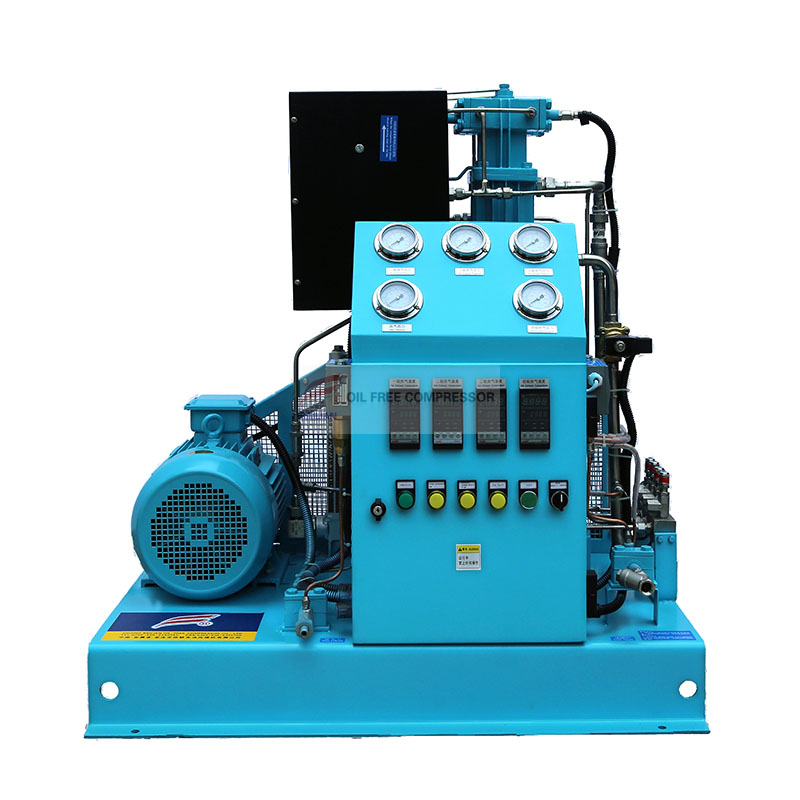
When engineering systems to handle concentrated oxidizers, safety supersedes all other design constraints. The single most critical safety feature of any modern system is the absolute, verifiable absence of combustible lubricants.
The element itself will not spontaneously ignite on its own. However, it is a remarkably powerful oxidizer that aggressively supports and violently accelerates the combustion of other materials. When introduced to a high-pressure environment, the ignition temperature of most common materials drops drastically. Fires in these environments burn exponentially hotter and faster than they ever would in normal atmospheric air.
Consequently, if even a microscopic droplet of standard petroleum-based lubricating oil enters a high-pressure chamber, the adiabatic heat generated by the compression stroke can cause that oil to auto-ignite. This instantaneous chemical reaction invariably leads to a catastrophic, lethal explosion.
To completely eliminate this risk, facilities must exclusively utilize an oil free oxygen compressor. These specialized machines are meticulously engineered without a single drop of petroleum-based oil anywhere near the gas path. Instead of liquid oil, they rely on advanced dry-lubrication metallurgy. Internal wear components are machined from highly durable, self-lubricating polymers like Polytetrafluoroethylene. Furthermore, the mechanical bearings are hermetically sealed and physically isolated from the cylinders to guarantee zero cross-contamination.
These machines are by no means one-size-fits-all. They are highly specialized and categorized based on their intended application, required terminal pressure outputs, and continuous flow rates. Understanding these functional distinctions is vital for accurate equipment procurement.
A medical oxygen compressor is designed with uncompromising adherence to global healthcare standards. These specialized units prioritize absolute gas purity, sanitary operation, and acoustic control. You will commonly find them operating quietly in the basements of large hospitals to maintain critical pipeline pressure, in dental clinics, and for pressurizing Hyperbaric Oxygen Therapy chambers. While they typically operate at moderate pressures, they require continuous unwavering reliability, as human lives depend directly on their steady output.
In stark contrast, industrial manufacturing applications demand raw power and robust, heavy-duty machinery. A high pressure oxygen compressor is built to withstand harsh, dusty environmental conditions while delivering extreme outputs. These machines routinely exceed 150 Bar or even 200 Bar. They are the unseen workhorses in sectors such as heavy metal laser cutting, commercial glass blowing, steel smelting, and large-scale chemical processing. The construction involves heavy-duty metallurgy designed to endure intense mechanical stress and thermal loads.
Serving a highly specific logistical role, an oxygen booster compressor does not pull gas from standard atmospheric pressure. Instead, it takes a supply that is already partially pressurized and amplifies it to a significantly higher pressure required for a localized piece of machinery. Because the inlet feed is already pre-compressed, boosters operate with remarkable mechanical efficiency, requiring far less electrical energy to reach their high terminal pressures.
For organizations that consume massive volumes daily, relying on third-party delivery services introduces severe logistical vulnerabilities. This operational friction is exactly why investing in an oxygen cylinder filling compressor has become a vital infrastructural upgrade for modern facilities.
Specifically, advanced diaphragm models designed for cylinder filling offer unparalleled purity. For example, a standard 12 cubic meter per hour diaphragm unit utilizes flexible metal membranes to completely isolate the gas from the hydraulic drive mechanism. This ensures 100 percent zero leakage and absolute purity retention. The actual filling process requires immense precision and strict thermodynamic management. Operators connect empty cylinders to a heavy brass high-pressure manifold.
Building on this preparation, the system initiates a deliberate slow-fill process. If a cylinder is filled too rapidly, the resulting adiabatic heat can severely weaken the molecular structure of the metal tank. Cooling systems actively reduce the temperature before it enters the manifold. Automated pressure switches continuously monitor the load, safely terminating the cycle the moment the cylinders reach their safe maximum capacity, typically around 150 Bar to 200 Bar.
While the fundamental physics remain identical across all machines, the engineering, material science, and regulatory compliance differ vastly depending on their end-use. Choosing the incorrect equipment for your sector can lead to rapid mechanical failure or severe safety hazards.
| Specification | Medical Applications | Industrial Applications |
|---|---|---|
| Primary Use Case | Hospitals, Therapy Chambers, Clinics | Metal cutting, Ozone generation, Smelting |
| Lubrication Type | Strictly 100% Oil-Free Dry Technology | 100% Oil-Free Dry Technology highly recommended |
| Regulatory Standards | FDA, CE, ISO 13485 | ISO 9001, ASME, CE |
| Operating Noise | Low Decibel Enclosures | Moderate to High Industrial Output |
| Typical Pressure | 4 Bar to 150 Bar | 10 Bar to Over 200 Bar |
Procuring commercial compression equipment is a significant capital expenditure. To ensure long-term operational efficiency and mechanical longevity, buyers must rigorously evaluate technical specifications against their facility's exact requirements.
Flow Rate Capacity
Flow rate dictates the sheer volume the machine can process within a specific timeframe, typically measured in Normal Cubic Meters per Hour or Liters Per Minute. To determine your requirement, audit your facility's peak consumption. Your chosen machine's capacity must comfortably exceed your peak demand to prevent dangerous pressure drops during critical operations.
Inlet and Outlet Pressure Matching
These machines do not magically generate gas; they merely pressurize what they are fed. Therefore, the unit must be perfectly calibrated to its source. The inlet pressure must align exactly with the output of your upstream generator. Simultaneously, the outlet pressure must meet the exact demands of your end-use application. If you only need to feed a hospital pipeline, 5 Bar is sufficient. If you are filling steel storage cylinders, you will require a robust 150 Bar to 200 Bar output.
Single-Stage vs. Multi-Stage Architecture
Achieving extreme high pressure cannot happen in a single violent stroke without generating catastrophic heat. Single-stage machines are excellent for low-pressure boosting up to 10 Bar. However, for high-pressure cylinder filling, a multi-stage system is mandatory. The gas is compressed in a primary large cylinder, cooled, passed to a secondary smaller cylinder, compressed again, and cooled again. This methodical volume reduction ensures thermal stability.
Thermal Management Systems
Thermal management dictates machine lifespan. Air-cooled systems utilize large external fans and finned heat exchangers to dissipate thermal energy into the room. These are ideal for smaller medical units or well-ventilated facilities. Conversely, heavy-duty industrial units operating continuously require closed-loop water-cooled systems. Water is exponentially more efficient at thermal transfer, ensuring the metallurgy survives heavy loads.
Maintenance Intervals and Component Lifespan
Because safe operation relies entirely on dry friction, internal components inevitably wear down. When evaluating a manufacturer, strictly inquire about the recommended service intervals. Premium machines utilizing advanced polymer piston rings typically offer 4000 to 8000 hours of continuous operation before requiring major overhauls. Readily available spare parts are non-negotiable factors for minimizing expensive facility downtime.
Advanced gas compression is an undeniable marvel of modern mechanical engineering. By forcing this life-saving and industrially vital element into highly pressurized, manageable volumes, we enable everything from deep-sea exploration to advanced trauma care and heavy manufacturing.
By understanding the thermodynamic principles at play, the absolute necessity of oil-free safety mechanisms, and the specific demands of your environment, facility managers can make highly informed procurement decisions. Transitioning away from volatile third-party liquid deliveries and investing in the right on-site infrastructure ensures total supply chain independence, unparalleled safety, and massive long-term cost savings.
If you are ready to upgrade your facility's infrastructure, eliminate delivery dependencies, and significantly reduce operational costs, it is time to explore professional-grade equipment. Evaluate your flow rate and pressure requirements, and source reliable, certified machinery directly from industry-leading manufacturers at https://www.oxygen-compressors.com to find the exact system tailored to your operational needs.
No, the gas itself is not technically flammable and will not spontaneously ignite. However, it is a remarkably powerful oxidizer. This means it aggressively supports and accelerates the combustion of other materials. In a high-pressure environment, materials that are normally difficult to ignite can catch fire easily and burn with explosive intensity. This harsh chemical reality is the primary reason why specialized dry equipment is strictly mandated by safety regulators.
These are two completely different pieces of machinery that perform highly complementary functions. A concentrator acts essentially as a molecular filter. It takes ambient room air and strips away the nitrogen, outputting a stream of pure product at a very low pressure. The secondary machine then takes that low-pressure feed and uses raw mechanical force to squeeze it into a high-pressure state, making it suitable for industrial tools or long-term storage.
Absolutely not. Attempting this is a fatal safety hazard. Standard industrial air units rely heavily on petroleum-based lubricating oils to keep their internal metal pistons moving smoothly at high speeds. If high-pressure oxidizers come into contact with even a microscopic droplet of petroleum oil, it will cause an immediate, catastrophic, and lethal explosion due to rapid uncontrolled oxidation.
The exact filling duration depends entirely on the flow rate capacity of the specific unit and the total volume of the cylinders connected to the manifold. However, even with the most powerful industrial models available, the process is deliberately paced. A standard batch generally takes between one to three hours to fill completely. This controlled methodology is a crucial safety mechanism designed to prevent intense adiabatic heat from structurally damaging the metal tanks.
For standard portable and industrial storage cylinders, the gas is routinely compressed to a range of 150 Bar to 200 Bar, which equates to roughly 2200 PSI to 2900 PSI. This extreme pressure allows a massive volume of usable gas to be stored in a relatively small, manageable physical footprint. Specialized industrial applications can sometimes require even higher pressures exceeding 300 Bar.
With proper routine maintenance, a high-quality industrial or medical unit can last for decades. The core heavy metallurgy is incredibly durable. However, the internal dry-lubrication wear parts, such as piston rings and guide rings, are consumable items. These specific components typically need replacement every 4000 to 8000 operating hours depending on the workload and operating environment.