
- All
- Product Name
- Product Keyword
- Product Model
- Product Summary
- Product Description
- Multi Field Search

Views: 0 Author: Site Editor Publish Time: 2026-08-07 Origin: Site


Industrial oxygen compression carries exceptionally high stakes across modern manufacturing and chemical facilities. The extreme reactivity of concentrated oxygen presents severe combustion risks under pressure. Strict purity requirements further complicate system engineering and equipment selection. Transitioning from broad system design to specifying the exact compressor technology requires careful planning. You must prioritize absolute safety, reliability, and continuous operational uptime.
Simply put, no single machine fits every possible application perfectly. Selecting the right unit demands matching strict thermodynamic realities to your unique site-specific demands. In this guide, we explore the essential parameters for evaluating industrial oxygen compression systems. You will learn how to match core mechanical technologies to specific operational profiles. We also cover critical safety mandates, material compliance, and performance efficiency metrics.
Engineers must establish baseline operational parameters first. This precision forms the foundation for reliable system design. You cannot select equipment based on broad assumptions. Accurate thermodynamic data prevents dangerous mismatching.
Best Practices: Always measure actual peak flow requirements before selection. Relying solely on average daily consumption causes severe undersizing.
Common Mistakes: Ignoring inlet pressure fluctuations from upstream PSA plants. Low inlet pressure severely degrades final volumetric output. It also forces the machine to work much harder.
Different mechanical designs serve entirely different operational profiles. Matching the wrong mechanism to your process causes rapid failure. We detail the three primary mechanisms below.
These units feature hermetically sealed compression chambers. A hydraulic fluid pushes a flexible metal membrane. The oxygen never touches the internal mechanical drive components. The gas remains isolated between thick steel plates.
This design utilizes standard piston-driven compression mechanics. The system uses specialized self-lubricating materials instead of liquid oil. PTFE rings ensure smooth cylinder movement. Single-acting and double-acting configurations exist for different flow needs.
These large machines perform dynamic compression via rapid rotating impellers. High-speed rotation imparts massive kinetic energy to the gas stream. Diffusers then convert this kinetic energy into static pressure.
Compressor Technology Comparison Chart
| Technology Type | Primary Mechanism | Ideal Application Fit | Primary Limitation |
|---|---|---|---|
| Diaphragm | Flexible metal membrane (Hydraulic) | High pressure, cylinder filling, ultra-pure | Lower flow rates, complex calibration |
| Reciprocating | Non-lubricated PTFE piston rings | Medium flow, PSA boosting, pipeline | Predictable wear parts, strict maintenance |
| Centrifugal | High-speed rotating impellers | Extreme volume, continuous base-load | Aerodynamic surge risks, poor low-flow fit |
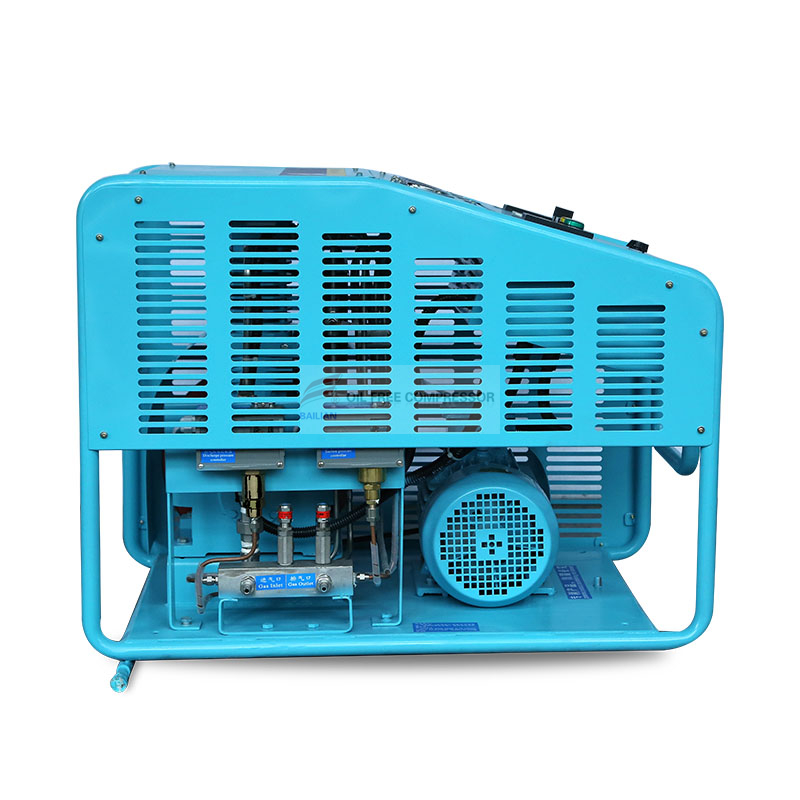
You must respect the combustion triangle in oxygen systems. Three elements create fire: fuel, oxygen, and an ignition source. In conventional pneumatic systems, lubricating oil acts as highly volatile fuel. Concentrated oxygen provides the ideal rapid oxidation environment. Heat generated during gas compression acts as the primary ignition source. This combination creates an extreme, immediate ignition hazard. We always mandate inherently safe equipment for these explosive environments.
True Oil-Free vs. Oil-Less
Understand the critical structural difference between these designs. A true oil free oxygen compressor eliminates oil from the crankcase entirely. No liquid lubricants exist anywhere inside the machine envelope. Conversely, oil-less designs use conventional oil-lubricated bottom ends. They simply use downstream filters to catch oil vapor. Filters attempt to clean the gas stream retrospectively. This filtered approach remains completely unacceptable for concentrated oxygen applications. A single microscopic filter failure causes catastrophic facility explosions.
Material Compatibility
Standard carbon steel poses severe friction sparking risks. High internal gas velocities can ignite standard metals quickly. Essential metallurgy includes brass, bronze, Monel, and specific stainless steels. These specialized metals resist rapid oxidation effectively. Engineers select soft seals designed to minimize internal mechanical friction. PTFE and specialized carbon composites prevent dangerous heat buildup entirely.
Evaluate long-term operational dynamics thoroughly before final selection. Upfront structural design choices heavily influence future system downtime. You must assess how the equipment performs over a decade of use.
Maintenance Realities & Wear Parts
Every machine features expected lifecycles for its critical components. Piston rings, rider bands, and discharge valves wear down predictably. You must track these degradation patterns closely. Scheduled downtime prevents sudden, dangerous mechanical failures. Diaphragms require strict, non-negotiable replacement intervals based on hours run. Engineers use acoustic monitoring systems to track structural health. These external sensors detect minor membrane failures early. This proactive approach prevents massive internal system damage.
Energy Efficiency
Evaluate specific power consumption across different operational loads. Measure thermodynamic efficiency in kilowatts per Nm³/h. Highly efficient units reduce overall facility energy draw significantly. You should request detailed performance curves from vendors. These technical curves reveal efficiency drops at partial loads. Some units run efficiently only at absolute peak capacity.
Cooling Requirements
Compare air-cooled against water-cooled thermal management systems. High-pressure operations generate substantial internal heat rapidly. Water-cooled designs offer superior thermal stability under extreme loads. They maintain lower gas discharge temperatures consistently. However, they demand complex site piping infrastructure and cooling towers. Air-cooled units simplify facility installation considerably. They rely on high-velocity fans and external finned tubes. Ambient facility temperatures dictate air-cooled system viability.
Industrial frameworks dictate strict, uncompromising engineering requirements. You must verify equipment compliance before final selection and installation.
Regulatory & Industry Frameworks
Equipment must meet established global industry standards strictly. EIGA Doc 27 provides vital safety guidelines for European operations. AIGA 071 outlines specific rules for Asian oxygen service equipment. These authoritative documents detail maximum allowable internal gas velocities. They also specify mandatory material thickness for containment integrity. You must verify your chosen equipment against these exact frameworks. Vendor claims require independent third-party verification.
"Cleaned for Oxygen Service"
This critical preparation protocol demands absolute adherence. Technicians degrease and inspect all wetted parts thoroughly. They complete this exhaustive process before commissioning the unit. Specialized solvents dissolve hidden grease trapped in metallic pores. Ultraviolet blacklight inspections detect microscopic hydrocarbon residues reliably. Independent certification proves the system remains safe for operation. You should never skip or rush this specific step.
Instrumentation & Fail-Safes
Robust monitoring systems protect your entire facility continuously. High-temperature alarms warn operators of thermal anomalies immediately. Low inlet pressure shut-offs prevent dangerous internal vacuum conditions. Vacuum conditions can pull atmospheric contaminants inward rapidly. Leak detection systems identify minor seal failures instantly. Redundant digital sensors offer secondary layers of protection. Automated shut-down sequences isolate the machine during critical faults.
Implementation Risk
Safe rollout requires careful site preparation planning. Engineers must implement proper structural vibration dampening concrete pads. Excessive vibration degrades internal compressor seals prematurely. Adequate ventilation systems disperse potential gas accumulations safely. You must ensure clear maintenance access around the entire unit. Cramped installations lead to neglected maintenance schedules.
We must reiterate specifying an oxygen compressor is a risk-management decision primarily. It remains much more than a simple equipment procurement task. You must prioritize absolute safety over standard operational metrics. Ignoring mechanical compatibility creates unacceptable facility hazards.
Summarizing the shortlisting logic provides a clear path forward. First, define your precise thermodynamic parameters accurately. Next, select the core mechanical technology matching those flow needs. Always verify true oil-free integrity rigorously without compromise. Finally, audit vendor compliance against strict industry safety standards.
We strongly encourage comprehensive engineering reviews before purchase. Examine your site-specific parameters collaboratively with a qualified technical vendor. Request documented proof of standard compliance. Protect your facility by prioritizing uncompromising design integrity.
A: Standard units contain incompatible metals and volatile lubricants. Oxygen reacts violently under pressure when exposed to hydrocarbons. An inherently oil-free design remains absolutely mandatory. Furthermore, manufacturers follow strict oxygen-cleaning protocols originally. They remove all microscopic contaminants to prevent sudden explosions. Modifying a standard air unit ignores these fundamental engineering safety requirements entirely.
A: Operational hours typically range from 4,000 to over 8,000 hours. The exact lifespan depends heavily on operating pressure and incoming gas purity. Strict adherence to scheduled maintenance also extends durability. Acoustic monitoring systems can track membrane integrity continuously. This helps operators schedule timely replacements before unexpected ruptures occur.
A: Piston compressors generally perform better for high-flow pipeline boosting. They handle low-to-medium pressures efficiently and economically. Conversely, diaphragm compressors handle extreme pressure demands better. You must specify a diaphragm unit for high-pressure cylinder filling. They also serve applications demanding absolute zero-contamination guarantees. Evaluate your required flow rate against final delivery pressure.
A: This defines a rigorous chemical and mechanical cleaning process. Factory technicians meticulously remove all combustible contaminants. They eliminate residual oils, greases, and microscopic manufacturing particulates. They perform ultraviolet blacklight inspections to verify absolute cleanliness. Equipment must pass these strict documented protocols before leaving the factory. It ensures internal surfaces will not ignite.