
- All
- Product Name
- Product Keyword
- Product Model
- Product Summary
- Product Description
- Multi Field Search

Views: 0 Author: Site Editor Publish Time: 2026-08-08 Origin: Site


Transitioning from bulk liquid oxygen delivery to on-site generation dramatically transforms how facilities secure their gas supply. It provides independence and reliability. However, this transition requires bridging a massive gap between low-pressure generation and high-pressure storage. Standard PSA (Pressure Swing Adsorption) generators produce oxygen at roughly 4 to 6 bar (60 to 90 psi). Standard storage cylinders require much higher pressures, typically between 150 and 200 bar (2200 to 2900 psi). Direct filling from a generator is physically impossible without secondary compression.
Our objective is to provide engineering, procurement, and facility managers with a strict technical framework. You will learn how to evaluate, size, and safely integrate secondary compression equipment into an existing or new PSA system. We will explore the core technologies available, key sizing criteria, safety imperatives, and system integration milestones. By understanding these parameters, you can deploy a reliable filling station while avoiding critical system failures.
Pressure Swing Adsorption relies on specialized zeolite molecular sieves. These sieves separate nitrogen from ambient air under specific pressure conditions. The physics of this process inherently limits the output pressure. If you push the generator pressure too high, the delicate molecular sieves break down. They undergo mechanical crushing, which ruins their adsorption capacity. Therefore, standard PSA technology naturally caps pure oxygen output at approximately 4 to 6 bar. This low-pressure output works perfectly for direct pipeline feeds in hospitals or low-pressure industrial networks. It does not work for cylinder storage.
Standard medical and industrial cylinders operate in a completely different pressure realm. To store a meaningful volume of gas in a portable metal cylinder, you must compress it immensely. Industry standards dictate cylinder filling pressures between 150 and 200 bar. Without this extreme compression, a standard steel or aluminum cylinder would empty in minutes. The massive difference between a 5 bar generator and a 200 bar cylinder creates an absolute physical barrier. You cannot force a low-pressure gas into a high-pressure vessel.
To bridge this gap, engineers utilize secondary compression. We introduce the PSA Oxygen Compressor as the critical integration point. A booster compressor takes the low-pressure feed from the generator and steps it up incrementally through multiple compression stages. It achieves the necessary 200 bar target without degrading the gas purity. This equipment acts as the vital link, enabling facilities to bottle their own gas safely.
System Pressure Comparison Chart
| System Component | Typical Pressure Range (Bar) | Typical Pressure Range (PSI) | Primary Function |
|---|---|---|---|
| PSA Generator Output | 4 - 6 Bar | 60 - 90 PSI | Gas separation and purity control |
| Intermediate Buffer Tank | 4 - 6 Bar | 60 - 90 PSI | Flow stabilization |
| Booster Compressor Output | 150 - 200 Bar | 2200 - 2900 PSI | High-pressure step-up |
| Storage Cylinder | 150 - 200 Bar | 2200 - 2900 PSI | Portable gas storage |
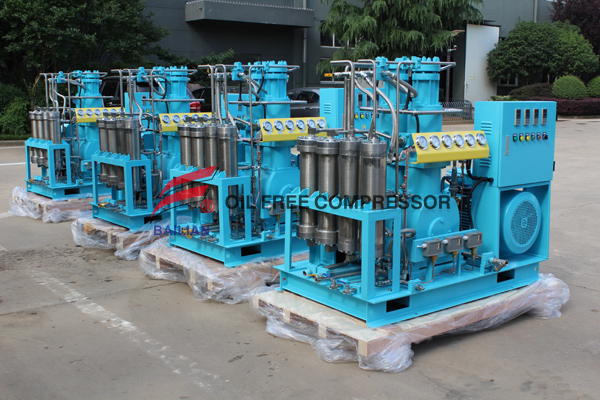
You cannot repurpose standard air compressors for oxygen service. Oxygen is not flammable by itself, but it aggressively accelerates combustion. It reacts violently with hydrocarbons. If high-pressure oxygen contacts even microscopic droplets of lubricating oil, it creates a severe explosion hazard. The auto-ignition temperature of materials drops drastically in pure oxygen environments. Therefore, any compressor handling this gas must guarantee 100% oil-free operation. This strict prerequisite dictates the engineering of all legitimate oxygen boosters.
Oil-free piston compressors represent the most common solution for standard filling operations.
Diaphragm compressors provide a completely different mechanical approach for highly specialized applications.
System sizing demands precise mathematical alignment. The compressor's intake capacity must never exceed the PSA generator's maximum continuous output. If you oversize the compressor, it will attempt to pull more gas than the generator produces. This creates negative pressure. A vacuum effect occurs, drawing ambient air backward through vents or seals into the system. This immediately ruins your oxygen purity and can permanently damage the generator's molecular sieves. Always size the oxygen generator booster compressor slightly below the generator's peak capacity.
Directly piping a generator into a compressor guarantees failure. You must install an intermediate oxygen receiver tank, often called a buffer tank. This vessel sits between the PSA unit and the booster. It equalizes the gas flow. A compressor pulls gas in pulsating strokes, while a generator pushes gas in steady, low-pressure waves. The buffer tank acts as a shock absorber. It prevents the compressor's aggressive suction strokes from starving the PSA generator. It also provides a stable intake pressure, ensuring the compressor runs smoothly.
You must rigorously assess your operational duty cycle. Determine whether your facility needs continuous (24/7) filling or intermittent, batch-based filling. Compressors carry specific duty cycle ratings. Running a standard intermittent compressor continuously beyond its rated cycle exponentially increases thermal wear. High pressure generates immense heat. If you ignore the duty cycle limits, the PTFE rings will melt, valves will warp, and the machine will fail. Always match the machine's thermal endurance rating to your actual daily filling targets.
Compressing gas to 200 bar generates massive thermodynamic heat. You must extract this heat effectively to maintain safety and equipment integrity. Air-cooled systems use large fans and finned tubes to dissipate heat. They are generally sufficient for smaller medical plants and intermittent operations. Water-cooled systems circulate chilled water through jackets around the compression cylinders. We consider water cooling mandatory for high-capacity, continuous industrial filling. Evaluate your facility's ambient temperature and choose the cooling method that keeps discharge temperatures strictly within safety limits.
You must automate your quality control. The filling system should never rely purely on human observation. The compressor must feature automated shut-off valves directly linked to the PSA generator’s oxygen analyzer. If the generator's oxygen purity drops below a predetermined setpoint (for example, falling below 93%), the PLC must trigger an immediate halt. This purity interlock prevents the compressor from pushing sub-standard gas into your storage cylinders. It protects end-users, especially in medical applications where gas purity remains a life-safety issue.
Oxygen systems forgive no engineering shortcuts. You must follow industry standards regarding material compatibility. Frameworks like the CGA (Compressed Gas Association) guidelines dictate acceptable materials. Engineers must construct all wetted parts from oxygen-compatible metals. We rely heavily on specific grades of brass, bronze, and stainless steel. Avoid standard carbon steel in high-velocity oxygen streams due to spark risks. Furthermore, all elastomers, O-rings, and gaskets must utilize Viton or specific fluoropolymers. Standard rubber or Buna-N seals will ignite under high-pressure oxygen exposure.
Redundant sensors form the backbone of a safe filling station. High-pressure compression introduces risks of thermal runaway and over-pressurization. You must install automated trip switches for abnormal conditions. If the final discharge temperature exceeds safe limits, the system must shut down before internal components ignite. Similarly, over-pressurization events at the filling manifold require immediate intervention. Pressure relief valves (PRVs) and electronic high-pressure cut-offs ensure the system never forces more than 200 bar into the manifold, protecting the cylinders from structural rupture.
Integrating a filling station requires systematic site preparation. Do not rush the infrastructure phase. High-pressure systems require dedicated environments.
Selecting the right equipment manufacturer dictates the long-term reliability of your on site oxygen cylinder filling station. Look beyond basic specifications and scrutinize the vendor's engineering pedigree. Use a strict checklist for buyers. First, do they offer comprehensive factory acceptance testing (FAT) before shipping? You need proof the machine hits its pressure targets. Second, do they provide verifiable "Cleaned for Oxygen Service" certification? Every component must be ultrasonically cleaned and inspected with UV light for hydrocarbon residue. Finally, evaluate their global support network. Ensure maintenance kits, specialized PTFE rings, and replacement valves are readily available in your specific region.
Integrating a booster compressor fundamentally transforms a PSA generator. It evolves your system from a simple direct-line supply into a comprehensive, highly resilient on-site utility. By mastering the pressure gap and respecting the strict safety protocols, facilities gain total independence over their gas logistics.
Your next step requires data gathering. Audit your current daily cylinder consumption. Map this data against your existing PSA generator’s excess capacity. Once you accurately define your available flow rate and target cylinder volumes, you can confidently request precise technical specifications from certified compressor vendors.
A: No. Standard generators output gas at less than 10 psi (often ~60 kPa) to 90 psi. Standard storage cylinders require upwards of 2,200 psi. An oxygen booster compressor is physically required to bridge this massive pressure gap. You cannot bypass this secondary compression step.
A: The compressor creates a vacuum effect. It pulls ambient air into the system backward. This drastically reduces your oxygen purity. It also potentially crushes the generator's molecular sieves and damages the compressor's internal valves. A properly sized intermediate buffer tank prevents this suction strain.
A: It varies by manufacturer and duty cycle. Generally, precision PTFE piston rings and guide valves require inspection and potential replacement every 2,000 to 4,000 operating hours. Adhering to this schedule maintains compression efficiency and prevents dangerous heat buildup from friction.
A: Absolutely not. Standard air compressors contain internal materials, tolerances, and design flaws not rated for pure oxygen. Even if cleaned, their operational friction and material composition carry an extreme, immediate risk of catastrophic fire or explosion when exposed to high-pressure oxygen.