
- All
- Product Name
- Product Keyword
- Product Model
- Product Summary
- Product Description
- Multi Field Search

Views: 0 Author: Site Editor Publish Time: 2026-10-25 Origin: Site


Are you breathing pure absolute oxygen from a standard machine? Many patients and facility managers naturally assume that standard machines deliver absolute purity when transitioning to respiratory therapy or upgrading facility infrastructure. In reality, most commercial and home units peak at around 96 percent. While this concentration is perfectly adequate for a living room, demanding industrial and medical fields require significantly more power, precision, and pressure.
In this comprehensive guide, we will break down the science behind purity levels and explore why absolute purity is not always necessary for optimal health. We will also delve into the heavy-duty compression systems that bridge the gap when critical care and industrial applications demand true high-purity gas storage.
Standard oxygen concentrators designed for home or routine clinical use do not produce absolute pure oxygen. Under optimal operating conditions, a high-quality concentrator will deliver an oxygen purity level ranging between 90 and 96 percent. To understand why absolute purity is mechanically impossible for these standalone devices, we must examine the underlying physics of the equipment.
Oxygen concentrators rely on a highly effective technology known as Pressure Swing Adsorption. The ambient air we breathe daily is composed of approximately 78 percent nitrogen, 21 percent oxygen, and 1 percent trace gases like argon and carbon dioxide. Rather than creating oxygen from nothing, the machine acts as an advanced molecular sieve.
The device draws in ambient air through a series of intake filters and compresses it. This pressurized air is then forced into specialized cylinders called sieve beds. These beds are packed with a crystalline material known as zeolite. Zeolite functions as a microscopic trap. Under pressure, it selectively adsorbs nitrogen molecules while allowing the smaller oxygen molecules to pass through into a collection tank. Once the pressure releases, the trapped nitrogen simply vents back into the room. This continuous rhythmic cycle results in a concentrated stream of therapeutic gas.
While the adsorption process is incredibly efficient at stripping away nitrogen, it cannot filter out all trace gases. Argon has a molecular size very similar to oxygen. Consequently, it slips through the zeolite sieve beds alongside the oxygen molecules. Because ambient air contains about 1 percent argon, the final concentrated output will inherently contain a small percentage of this inert gas.
Achieving absolute purity is mechanically impossible with standard standalone concentrators unless they pair with secondary complex purification processes. The remaining 4 to 10 percent of the output consists of these harmless trace gases. From a field engineering standpoint, these trace elements have absolutely no negative impact on standard respiratory therapies.
For individuals newly prescribed to oxygen therapy, realizing their machine does not provide absolute pure gas can initially cause unnecessary panic. However, from a strictly physiological and medical standpoint, 93 percent purity is overwhelmingly sufficient for the vast majority of therapeutic applications.
Human blood oxygen saturation measures the percentage of hemoglobin binding sites in the bloodstream that are actively occupied by oxygen. Medical professionals monitor these levels closely to determine the necessity and exact dosage of supplemental oxygen.
Imagine a patient managing a chronic condition such as Chronic Obstructive Pulmonary Disease at home. The primary goal of their therapy is simply to elevate the saturation level back into the safe 90 to 95 percent range. The goal is never to flood the body with pure gas.
The human lungs are remarkably efficient at processing concentrated gas. When a patient inhales 90 to 96 percent concentrated oxygen, the partial pressure of oxygen in the alveoli increases significantly compared to breathing standard room air. This facilitates rapid gas exchange into the bloodstream. Clinical evidence consistently demonstrates that administering 93 percent pure oxygen is virtually identical in therapeutic efficacy to administering absolute pure oxygen for these chronic conditions.
Looking at actual facility data and recent market analysis regarding respiratory therapy and industrial gas supply, a massive pivot in infrastructure planning is underway. Global healthcare and industrial demands are expanding rapidly. Consequently, there is a surging preference for localized high-purity oxygen generation rather than relying solely on erratic liquid oxygen truck deliveries.
Facilities are increasingly recognizing that generating low-pressure oxygen is only half the battle. Supply chain disruptions have taught hospital administrators and plant managers a hard lesson. To truly secure their supply chains, hospitals and manufacturing plants are investing heavily in robust on-site compression technologies. This trend highlights a critical industry realization. The ability to independently store and pressurize gas is where true operational security lies.
Understanding the fundamental distinction between oxygen generation and oxygen storage is crucial for selecting the right equipment for your specific medical or industrial applications. Let us look at a direct comparison.
| System Type | Typical Purity | Output Pressure | Best Application |
|---|---|---|---|
| Standard Concentrator | 90% - 96% | Low - 5 to 20 PSI | Home care, basic clinical use |
| High-Pressure Cylinder | 99% - 100% | High - up to 3000 PSI | Emergency trauma, portable industrial use |
| On-Site Compressor System | 93% - 99%+ | Custom - up to 2175 PSI | Hospital pipelines, cylinder filling stations |
An oxygen concentrator is an active generator. As long as it has a continuous power supply and access to ambient room air, it produces an endless supply of purified gas. Conversely, an oxygen cylinder is a finite storage vessel containing a specific limited volume of compressed gas. Cylinders hold one distinct advantage. They store oxygen at maximum purity levels and deliver it at extremely high flow rates without requiring electricity at the point of use.
While standard concentrators are sufficient for continuous low-pressure delivery at home, they are fundamentally incapable of storing oxygen. They cannot deliver gas at the extreme pressures required by modern medical and industrial infrastructure. When a facility requires pure oxygen storage for emergency backup, the technological requirement shifts from simple generation to advanced pressurization.
To make an informed purchasing decision, it is vital to understand the mechanical distinction between generating equipment and pressurizing equipment. A standard concentrator creates purified gas from ambient air but outputs this gas at very low pressures, typically between 5 and 20 PSI. An oxygen compressor does not generate gas. It intakes the purified oxygen provided by a generator and mechanically reduces its volume to significantly increase its pressure. This pressurized gas can then be pushed through complex piping networks or compressed into dense states for long-term storage.
In large-scale healthcare facilities, centralized gas generation is far more efficient than placing individual concentrators in every patient room. Modern hospitals utilize a specialized medical oxygen compressor to take the gas produced by a central on-site generator and forcefully push it through the building pipeline infrastructure.
In sprawling industrial complexes or massive hospital campuses, oxygen traveling through miles of piping loses pressure due to friction and distance. To counteract this natural pressure drop, engineers install an oxygen booster compressor at strategic points along the pipeline network. The booster takes the existing pipeline oxygen and steps up the pressure just enough to maintain the required flow rate at the final destination.
For medical supply companies, emergency responders, and industrial welders, oxygen must be highly mobile. This requires storing the gas in heavy-duty steel or aluminum cylinders. Because oxygen must be highly compacted to fit a usable volume into a portable tank, a heavy-duty high pressure oxygen compressor is utilized.
These robust machines take low-pressure oxygen and compress it up to 2000 to 3000 PSI. By utilizing a multi-stage compression process, the equipment safely compacts the gas. This very process is the backbone of the portable oxygen tank industry. When a local clinic or welding shop needs to bottle their own gas, they install a dedicated oxygen cylinder filling compressor to handle the daily load.
When dealing with concentrated oxygen, safety is the absolute paramount engineering concern. Oxygen itself is not flammable, but it is a powerful oxidizer that violently accelerates combustion. In a standard air compressor, petroleum-based lubricating oils reduce friction. If these oils come into contact with highly pressurized oxygen, the heat of compression instantly triggers a catastrophic explosion.
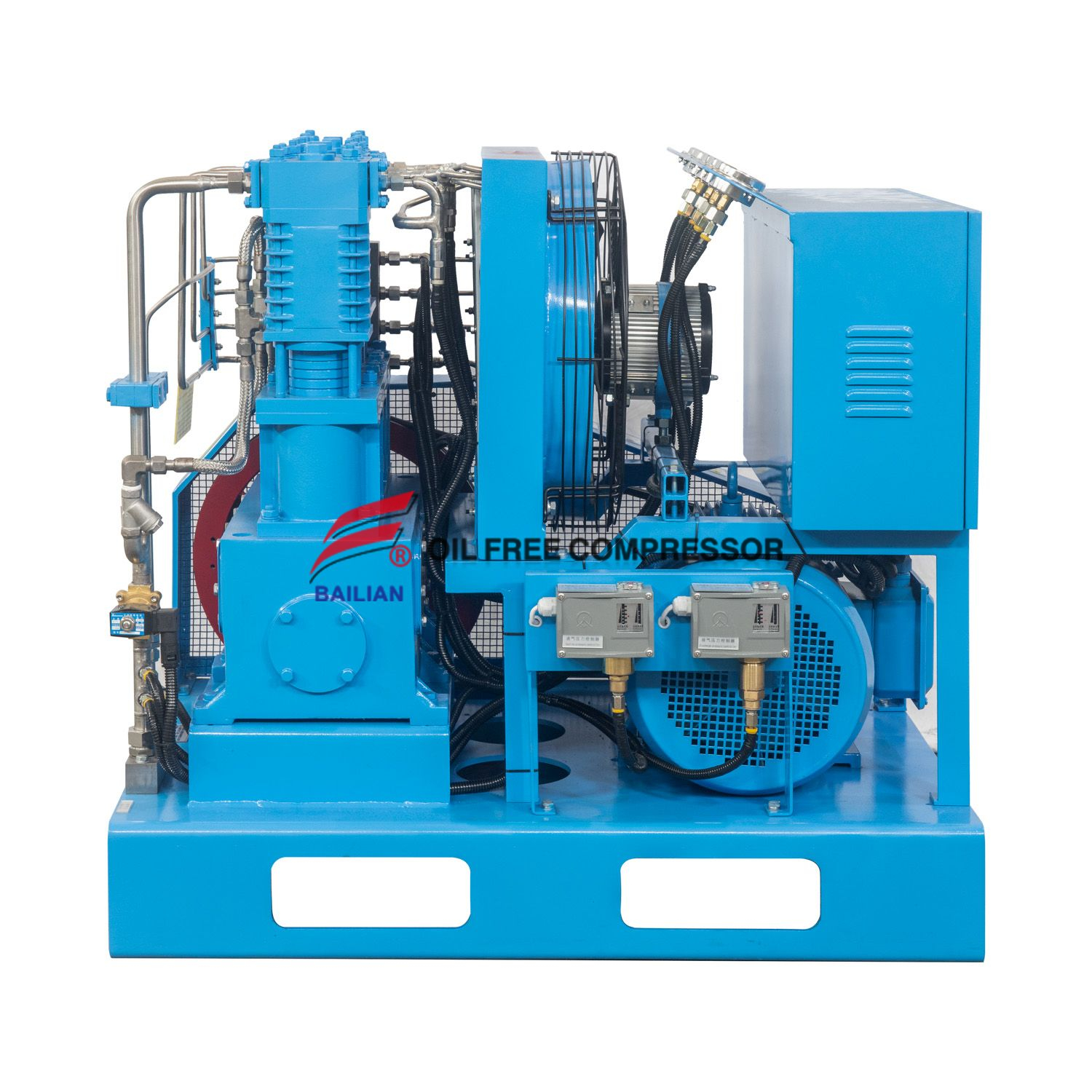
To completely eliminate this risk, facilities must strictly use an oil free oxygen compressor. Let us look at professional-grade hardware like the GOW-18/4-150/100 model. This specific unit operates entirely without oil. It takes a low intake pressure of 4 bar and safely ramps it up to a massive 150 bar discharge pressure. This equals roughly 2175 PSI. Operating at a capacity of 100 Nm3/h, it utilizes advanced self-lubricating materials like Teflon-based piston rings to ensure the medical gas remains completely free of hydrocarbon vapor contamination.
Purity is only one half of the respiratory equation. The other half is the flow rate. Even if a system delivers absolute pure oxygen, it will be medically ineffective if it cannot deliver the volume of gas the patient physically requires.
Oxygen delivery systems generally operate using one of two methods. Continuous flow delivers a steady uninterrupted stream of oxygen measured in Liters Per Minute. Regardless of whether the patient is inhaling or exhaling, the machine pushes gas at a constant rate. Pulse dose technology is primarily found in portable units. The machine detects the negative pressure of the user inhalation and delivers a quick burst of oxygen exactly when the user breathes in.
Medical professionals prescribe oxygen based on specific flow rates to maintain a healthy blood oxygen saturation. When selecting equipment, the machine maximum output must comfortably exceed the prescribed needs to account for potential respiratory degradation over time. A higher flow rate is not inherently better. It must strictly match the physician prescription to avoid complications.
Purchasing respiratory or industrial oxygen equipment is a significant capital investment. Making the wrong choice can lead to inadequate medical care, severe safety hazards, or costly operational inefficiencies. Evaluate these specific engineering and sizing rules before finalizing your procurement decision.
Portability Versus Output: Portable units offer unparalleled freedom for individual users. However, a machine small enough to carry on a shoulder strap simply lacks the internal sieve bed capacity to produce high continuous flow rates. Most portable units max out at 1 to 3 Liters Per Minute on continuous settings.
Home Use Versus Facility Use: For a single patient managing a chronic respiratory condition at home, a standard 5 or 10 Liters Per Minute stationary concentrator is the most practical choice. In contrast, clinics and industrial sites requiring multiple delivery points find individual concentrators highly inefficient. These environments require a centralized generator paired with a robust compressor network.
Maintenance and Operating Costs: Standard concentrators require relatively simple maintenance, primarily consisting of regular intake filter replacements. High-pressure compressor systems demand rigorous scheduled industrial maintenance. Valves, piston rings, and cooling systems must be inspected by certified technicians to ensure the system remains entirely oil-free and safe from combustion risks.
Standard oxygen concentrators provide 90 to 96 percent oxygen purity by efficiently filtering nitrogen from ambient air. For the vast majority of patients managing chronic respiratory conditions at home, this level of purity is medically approved, highly effective, and perfectly safe for daily therapies.
Industrial manufacturing and critical medical facilities operate under much stricter parameters. They often require maximum purity levels and massive delivery volumes. High-pressure cylinder storage and facility-wide pipeline distribution demand specialized fail-safe equipment. To meet these rigorous demands, facility managers cannot rely on generation alone. You must pair a high-purity generator with a proper oil-free compressor system to ensure safety, reliability, and continuous flow.
Yes. An oxygen purity of 90 to 96 percent is the established medical standard for treating chronic obstructive pulmonary disease, asthma, and most chronic respiratory issues safely. Clinical studies consistently demonstrate that this purity level is highly effective at raising blood oxygen saturation to healthy levels above 95 percent.
You cannot fill high-pressure tanks with a standard home concentrator alone. Standard machines completely lack the mechanical force required to compress gas into a dense state. You need a specialized cylinder filling compressor designed to safely handle high-pressure oil-free gas transfer. Attempting to modify home equipment to fill tanks is a severe fire hazard and is strictly prohibited by safety regulations.
A concentrator extracts oxygen from the ambient room air to provide a steady low-pressure stream of purified gas. An oxygen compressor does not create oxygen. Instead, it takes the purified gas generated by a concentrator and mechanically increases its pressure. This high-pressure state allows the gas to be stored in metal cylinders or forcefully pushed through extensive hospital pipelines.
Breathing absolute pure oxygen for extended periods can lead to a dangerous condition known as oxygen toxicity. Prolonged exposure can cause severe cellular damage to the lungs, leading to inflammation, fluid buildup, and potential central nervous system issues. Supplemental oxygen is a prescription drug. Always follow exact prescribed flow rates and durations.
Pure oxygen under high pressure is a highly reactive oxidizer. If even a microscopic amount of petroleum-based lubricating oil mixes with pressurized oxygen, the intense heat generated by the compression process can cause spontaneous combustion. Utilizing an oil-free system is a strict non-negotiable safety requirement for any medical or industrial gas application.
Yes. Most modern stationary oxygen concentrators are engineered for continuous round-the-clock operation. Their internal compressors and cooling fans are built to withstand 24/7 usage to support patients who require continuous flow therapy during sleep. However, they should be placed in well-ventilated areas to prevent overheating.
An oxygen concentrator alarm typically triggers due to a disruption in normal operation. The most common reasons include power failures, restricted airflow from a blocked intake filter, kinked delivery tubing, or a drop in oxygen purity levels. If the machine detects that purity has dropped below 80 percent, it will sound an alarm to alert the user of inadequate therapeutic delivery.
Ready to secure your facility's gas infrastructure? Upgrading from unreliable liquid oxygen deliveries to a robust on-site generation and compression system is a critical operational advantage. Whether you need pipeline boosters or high-pressure cylinder filling stations, you need equipment engineered for absolute safety. Visit Oxygen-Compressors.com today to explore our full range of 100% oil-free compression systems and find the exact specifications required for your demanding applications.