
- All
- Product Name
- Product Keyword
- Product Model
- Product Summary
- Product Description
- Multi Field Search

Views: 0 Author: Site Editor Publish Time: 2026-09-27 Origin: Site


Compressing an industrial gas is not simply a matter of increasing pressure. The gas may be valuable, environmentally sensitive, corrosive, reactive, flammable, toxic, difficult to seal, or easily contaminated. Each of these characteristics can change the compressor materials, sealing system, cooling arrangement, lubrication strategy, monitoring, and maintenance requirements.
This is especially important when comparing an SF6 compressor and special gas compressor. SF6 compressors are commonly associated with gas recovery and recycling during the servicing of gas-insulated electrical equipment. Special gas compressors cover a much broader range of media and industrial processes, so their design must be based on the exact gas composition and operating conditions.
Safe gas handling therefore starts with understanding the gas itself. Pressure, flow, purity, moisture, temperature, chemical compatibility, recovery requirements, and the final use all need to be defined before a compressor configuration is selected.
Anqing Bailian Oil Free Compressor Co.,LTD. provides dedicated SF6 Compressor and Special Gas Compressor ranges for recovery, transfer, pressure boosting, recycling, and customized industrial gas applications.
An SF6 compressor is specifically engineered around sulfur hexafluoride service. SF6 is widely known for its strong dielectric and arc-quenching properties and has historically been used in circuit breakers, gas-insulated switchgear, substations, and other electrical equipment.
During maintenance, repair, manufacturing, or decommissioning of this equipment, the gas may need to be removed and stored rather than released. The compressor therefore becomes part of a closed recovery system.
A special gas compressor is a broader category. It may be configured for refrigerants, fluorinated gases, natural gas, nitrous oxide, process gases, chemical gases, or other non-standard media that require something different from a conventional air compressor.
The design challenge is therefore different.
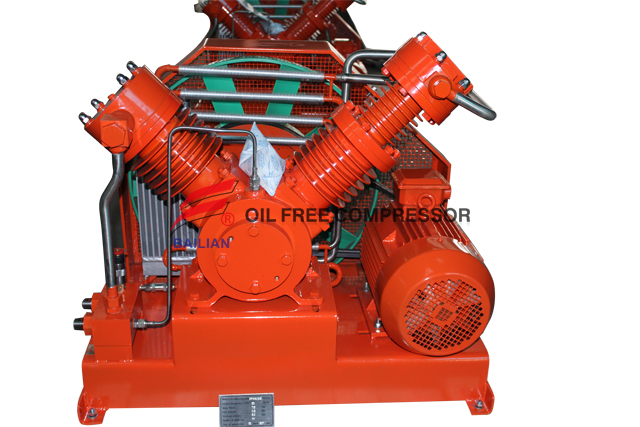
With SF6, important priorities include gas-tightness, oil-free recovery, gas purity, moisture control, and minimizing environmental release. With specialty gases, the design priorities change according to the medium. A flammable gas may require one safety philosophy, while a corrosive or chemically reactive medium may require a completely different material and sealing strategy.
Design Factor | SF6 Compressor | Special Gas Compressor |
|---|---|---|
Working Medium | Defined: sulfur hexafluoride | Depends on application |
Typical Use | Recovery, recycling, transfer | Recovery, boosting, transfer, process supply |
Oil-Free Gas Path | Highly valuable | Often required depending on gas/process |
Gas-Tightness | Critical | Depends on toxicity, value and gas properties |
Material Selection | SF6-compatible materials | Must be selected for exact gas |
Environmental Control | Major priority | Medium dependent |
Purity Requirement | Important for reuse in electrical equipment | Application dependent |
Moisture Control | Important | Gas dependent |
Safety Strategy | Relatively well defined | Must be customized |
Compressor Configuration | Recovery-oriented | Highly application-specific |
The most important purchasing lesson is that “special gas compressor” is not a complete technical specification. The actual gas medium must always be identified.

SF6 recovery is fundamentally a containment process.
The compressor removes SF6 from electrical equipment and increases its pressure so that the gas can be transferred into a recovery vessel, cylinder, or storage system. If the compressor itself leaks significantly, the purpose of the recovery process is undermined.
SF6 has a very high global warming potential, so minimizing emissions during servicing and gas handling is particularly important. Recovery equipment, leak detection, good operating practices, and reliable sealing can all reduce unnecessary releases.
Potential gas-loss points include:
Shaft seals
Piston packing
Valve assemblies
Pipe joints
Flanges
Instrument connections
Hoses
Recovery cylinders
Filling connections
Compressor gas-tightness should therefore be viewed as part of the complete recovery system.
Bailian's SF6 compressor configurations use dedicated shaft-sealing solutions such as magnetic-fluid or mechanical sealing depending on the model. Its SF6-6/2-50 Completely Oil-Free V-Type SF6 Compressor, for example, uses magnetic-fluid sealing together with stainless-steel gas-contacting components.
The objective is not simply to achieve pressure. It is to transfer as much recoverable gas as practical without unnecessary contamination or loss.
Recovery compressors may operate very differently from ordinary booster compressors.
At the beginning of a recovery cycle, the equipment being serviced may contain gas at a relatively useful pressure. As recovery continues, suction pressure falls.
The compressor must still remove as much recoverable SF6 as the process requires.
This makes suction-pressure range an important selection parameter.
A compressor that performs well at higher inlet pressure may provide substantially lower capacity as inlet pressure falls. Buyers should therefore specify both normal and minimum expected suction pressure when discussing an SF6 recovery system.
Tip: For recovery applications, ask about performance across the full suction-pressure range rather than only the nominal flow rate.
Oil-free compression is particularly valuable when recovered SF6 is intended to be purified and reused.
Lubricating oil introduced into the gas path can contaminate the recovered gas and increase the burden on downstream filtration or purification equipment.
In electrical applications, maintaining gas cleanliness is also important because the recovered SF6 may return to sensitive high-voltage equipment.
An oil-free reciprocating compressor does not necessarily mean that every moving component operates without any lubrication.
Bearings and drive components outside the compression chamber may still use suitable grease or lubrication.
The important distinction is that lubricating oil is prevented from entering the process-gas cylinder.
Self-lubricating piston rings, guide rings, packing materials, and carefully selected wear components can support dry or oil-free gas compression.
Bailian's SF6 Compressor series uses oil-free gas-path designs intended to preserve gas purity during recovery and reuse.
If oil enters the recovered gas stream, additional filtration may be required before the SF6 can be reused.
Oil contamination can also affect valves, filters, storage equipment, and other components in the recovery system.
Preventing contamination at the compressor can therefore be more efficient than trying to remove it afterward.
The same principle applies to many special gas compressors. If the process gas must remain clean, an oil-free compressor can reduce one significant contamination source.
The term “special gas” can describe gases with completely different hazards and physical properties.
Bailian's special gas product range includes configurations for natural gas, dinitrogen tetroxide-related service, fluorinated media, refrigerant recovery, and other customized gas applications.
These gases cannot be handled using one universal compressor configuration.
The engineering process must begin with a gas datasheet.
The compressor cylinder, valves, piping, seals, packing, coolers, gaskets, and instruments all contact the process gas.
A material that performs well with nitrogen may be unsuitable for another chemical medium.
Depending on the gas, engineers may need to evaluate:
Corrosion
Oxidation
Chemical reaction
Solvent effects
Seal swelling
Permeation
Material embrittlement
Thermal stability
Moisture sensitivity
Stainless steel may be appropriate for many gases, but it is not automatically compatible with every specialty medium.
Likewise, common elastomers and sealing materials can behave very differently when exposed to refrigerants, hydrocarbons, oxidizing gases, or fluorinated chemicals.
The actual gas composition, concentration, pressure, temperature, and moisture content should therefore be reviewed before materials are finalized.
A specialty gas may be:
Flammable
Oxidizing
Toxic
Corrosive
Environmentally sensitive
Asphyxiating
Chemically reactive
Expensive and difficult to replace
The compressor design should respond to the actual hazard rather than using one generic “special gas” safety package.
For flammable gases, leak prevention and hazardous-area electrical requirements become especially important.
For toxic or corrosive gases, containment, ventilation, materials, and emergency handling may dominate the design.
For valuable or environmentally sensitive gases, recovery efficiency and minimizing vent losses may receive greater attention.
This is why the Special Gas Compressor category should be treated as a customized engineering platform rather than a single standard compressor type.
Gas purity is a major consideration in both SF6 recovery and specialty-gas compression.
However, the required purity level depends on what happens to the gas after compression.
SF6 recovered from electrical equipment should not automatically be assumed to have the same condition as new gas.
Depending on service history, the recovered stream may contain:
Moisture
Particles
Air
Process contamination
Decomposition products
Gas exposed to electrical arcing or equipment faults may require additional attention because decomposition products can form.
The compressor is not a purification device.
A complete SF6 handling system may therefore include filtration, drying, evacuation, gas analysis, storage, and other treatment steps in addition to compression.
The compressor's role is to move and pressurize the gas without adding unnecessary contamination.
Purity requirements vary considerably for other gases.
A refrigerant-recovery application may prioritize preventing oil or moisture contamination.
A specialty chemical process may need the compressor to preserve a precisely controlled gas composition.
A high-purity industrial gas may require very low hydrocarbon contamination.
Some process gases may already contain controlled mixtures, so the compressor needs to handle the complete composition rather than one nominal component.
For this reason, buyers should provide more than the gas name.
Useful information includes:
Main gas component
Gas purity
Minor components
Moisture
Particles
Hydrocarbon content
Possible corrosive species
Process contaminants
This information can affect materials, sealing, filtration, and maintenance planning.
Every compressor generates heat, but the effect of that heat depends on the working gas.
Compression ratio, specific heat, inlet pressure, flow rate, number of stages, and cooling method all influence discharge temperature.
For specialty gases, temperature may also affect chemical stability, corrosion, seal life, or phase behavior.
When the required pressure increase becomes large, compression can be divided across multiple stages.
Interstage cooling reduces gas temperature before the next stage and helps control the load on valves, piston rings, packing, and cylinders.
SF6 recovery compressors may use one or multiple stages depending on suction and storage pressures.
Bailian's Oil-Free V-Type SF6 Gas Compressor SF6-24/2-50, for example, uses two-stage compression for its specified operating range.
Special gas compressors may require single-, double-, three-, or four-stage configurations depending on the gas and total compression ratio.
The number of stages should be selected from thermodynamic requirements rather than simply from a preferred machine layout.

Smaller or moderate-duty systems may use air cooling because it simplifies installation.
Water cooling can provide more stable heat removal for higher flow rates, larger pressure ratios, or continuous-duty operation.
The best cooling system depends on:
Gas properties
Capacity
Compression ratio
Ambient temperature
Duty cycle
Installation location
Cooling-water availability
Temperature monitoring should be integrated where excessive discharge temperature could affect reliability or safety.
A conventional filling compressor usually receives gas from a controlled supply and increases its pressure for storage or cylinder filling.
SF6 recovery works in the opposite direction conceptually: the objective is to remove gas already contained inside equipment and preserve it for reuse.
That changes how the compressor is evaluated.
Suppose a circuit breaker is being serviced.
The goal is not merely to transfer the easily accessible gas. The recovery system may need to continue operating as equipment pressure declines so that as little SF6 as practical remains before the equipment is opened.
This makes low-pressure suction performance particularly relevant.
Recovery time is also important because electrical maintenance schedules may depend on how quickly equipment can be evacuated and returned to service.
Recovered SF6 may be compressed into appropriate storage vessels until purification, reuse, or further processing.
Pressure and temperature must be controlled throughout this process.
The compressor should be integrated with suitable vessels, valves, filters, instruments, and safety devices designed for the intended SF6 service.
Bailian identifies circuit-breaker repair and maintenance as a primary application for its SF6 compressor range through its Gas Compressor Applications page.
There is no single safety list that applies identically to every specialty gas, but several engineering controls recur across properly designed systems.
Pressure protection is one.
Compressors should have appropriate relief devices and control logic so abnormal discharge pressure does not continue unchecked.
Temperature is another.
High discharge temperature can damage seals, valves, piston rings, or process gas, so temperature monitoring may trigger alarms or shutdowns.
Gas leakage also deserves systematic attention.
Depending on the medium and site, systems may require:
Gas detectors
Ventilation
Closed vent systems
Emergency shutdown
Double containment
Pressure alarms
Temperature alarms
Flow monitoring
Purge systems
Check valves
Hazardous-area electrical equipment
Not every installation needs every feature.
The correct system comes from a hazard assessment of the actual gas, compressor, piping, storage, building, and downstream process.
Bailian's SF6 product specifications also emphasize that incoming gas should be dry and free of particulate contamination.
This is important beyond SF6.
Particles can damage sealing surfaces, valves, cylinder walls, and piston rings. Moisture can change corrosion behavior and, with certain gases, create chemically aggressive conditions.
Upstream filtration and moisture control can therefore protect both gas quality and compressor life.
It should not be assumed.
A compressor may physically be capable of creating the required pressure, but that does not mean every internal component is compatible with a different gas.
Changing the working medium can alter:
Motor power
Compression temperature
Valve behavior
Seal leakage
Material compatibility
Corrosion risk
Required clearance
Safety classification
Required monitoring
Purity requirements
Cross-contamination is another consideration.
A machine previously used with one process gas may not be sufficiently clean for another high-purity medium.
Gas conversion should therefore be reviewed by the compressor manufacturer.
For new projects, specifying the exact gas from the beginning normally produces a safer and more reliable system.
A special-gas compressor cannot be accurately selected from flow and pressure alone.
The process gas should be described as completely as practical.
A useful inquiry should include:
Gas name
Complete gas composition
Gas purity
Moisture content
Possible particles
Inlet pressure
Minimum inlet pressure
Inlet temperature
Discharge pressure
Required capacity
Continuous or intermittent operation
Daily operating hours
Recovery, transfer, filling, or process use
Cooling-water availability
Ambient temperature
Installation altitude
Voltage and frequency
Hazardous-area requirements
Materials restrictions
Leakage requirements
Downstream purity requirements
For SF6, buyers should also explain whether the system is being used for circuit-breaker servicing, switchgear manufacturing, gas recovery, transfer, or another application.
For a special gas compressor, the detailed composition is even more important because trace components can sometimes determine compatibility or corrosion requirements.
Anqing Bailian Oil Free Compressor Co.,LTD. manufactures oil-free gas compressors for more than the standard oxygen, nitrogen, hydrogen, CO₂, helium, and argon applications. Buyers can review the company's Special Gas Compressor, SF6 Compressor, and technical downloads when preparing project data.
Tip: For unusual gases, send the manufacturer an SDS and complete process-gas composition together with the compressor datasheet. A gas name by itself may not provide enough information for material and safety review.
Safe handling is the central issue when comparing an SF6 compressor and special gas compressor.
An SF6 compressor is primarily designed around closed gas recovery, low leakage, oil-free compression, purity preservation, and efficient transfer during electrical equipment servicing. Because SF6 emissions should be minimized, gas-tight sealing and reliable recovery performance are especially important.
A special gas compressor presents a broader engineering challenge because the working medium can vary dramatically. One gas may be flammable, another corrosive, another highly reactive, and another mainly sensitive to contamination. Materials, seals, cooling, instrumentation, electrical design, and safety systems therefore need to be selected around the actual medium.
For both categories, oil-free compression can help preserve gas cleanliness and simplify reuse. Reliable sealing reduces product loss, while correct staging and cooling control pressure and temperature. Upstream filtration, drying, monitoring, and safe storage complete the gas-handling system.
Anqing Bailian Oil Free Compressor Co.,LTD. provides SF6 Compressors for gas recovery and electrical-equipment maintenance, as well as Special Gas Compressors configured around different industrial gases, pressures, flows, and process requirements.
The correct compressor should therefore be selected from the gas properties and complete process conditions—not simply from the required discharge pressure.
A: An SF6 compressor is commonly used to recover, transfer, pressurize, and store sulfur hexafluoride during maintenance, manufacturing, or servicing of gas-insulated electrical equipment.
A: Oil-free compression helps prevent lubricant from contaminating recovered SF6, making downstream purification and gas reuse easier while protecting gas cleanliness.
A: SF6 is a highly effective electrical insulating gas but also has a very high global warming potential. Recovering and reusing the gas helps reduce emissions and gas losses.
A: A special gas compressor is configured for a specific non-standard gas or gas mixture. Materials, seals, pressure stages, cooling, and safety features are selected according to that medium.
A: Not automatically. Material compatibility, leakage, power requirements, safety classification, gas purity, and sealing can change significantly between gases. Any gas change should be reviewed by the manufacturer.
A: Effective sealing minimizes loss during recovery and storage. Shaft seals, piston packing, valves, fittings, and pipelines all contribute to overall gas-tightness.
A: Depending on its condition, recovered SF6 may contain moisture, particles, air, or decomposition products and may require filtration, drying, analysis, or purification before reuse.
A: Provide complete gas composition, purity, moisture, inlet pressure, outlet pressure, flow rate, temperatures, duty cycle, final application, site conditions, and any hazardous-area or material requirements.