
- All
- Product Name
- Product Keyword
- Product Model
- Product Summary
- Product Description
- Multi Field Search

Views: 0 Author: Site Editor Publish Time: 2026-08-09 Origin: Site


Compressing carbon dioxide presents distinct challenges compared to handling air or natural gas. Its heavy molecular weight changes aerodynamic behaviors significantly. The gas features unique thermodynamic properties. It frequently experiences unexpected phase changes during compression cycles. Selecting an incorrect pressure profile causes severe mechanical issues. Poor equipment design leads directly to catastrophic seal failures. You may also face aggressive carbonic acid corrosion. Inefficient power consumption often ruins project viability. These failures routinely jeopardize carbon capture or processing facilities. We will provide an evidence-based framework here. You can use it to identify exact pressure ranges for your specific applications. You will learn how to evaluate the right CO2 Compressor safely and efficiently. We want you to feel confident making technical decisions. Proper planning prevents catastrophic downtime and ensures long-term operational success.
Carbon dioxide behaves unpredictably under pressure. It transitions between gas, liquid, and supercritical fluid states easily. These phase changes pose severe risks during the compression cycle. A sudden pressure drop might freeze the gas into dry ice. Solid dry ice blocks valves immediately. It also destroys delicate internal components. You must control thermodynamic parameters strictly to maintain a stable gas phase. Operators cannot treat carbon dioxide like standard atmospheric air.
The critical point occurs exactly at 73.8 bar and 31.1°C. Operating near this threshold alters fluid density dramatically. The gas suddenly adopts liquid-like density while retaining gas-like viscosity. This supercritical phase requires highly robust compressor stage design. Standard aerodynamic models fail under these extreme density shifts. industrial CO2 compression demands specialized engineering to handle these immense mechanical loads. Equipment must withstand intense vibration and potential aero-instability.
Moisture presents another critical threat. Even trace amounts of water interact poorly under pressure. Water and carbon dioxide combine to form carbonic acid. This acid is highly corrosive to standard carbon steel. You must implement strict material grade specifications to prevent rapid degradation. Stainless steel internals become mandatory rather than optional. Ignoring the moisture threat leads directly to catastrophic equipment failure.
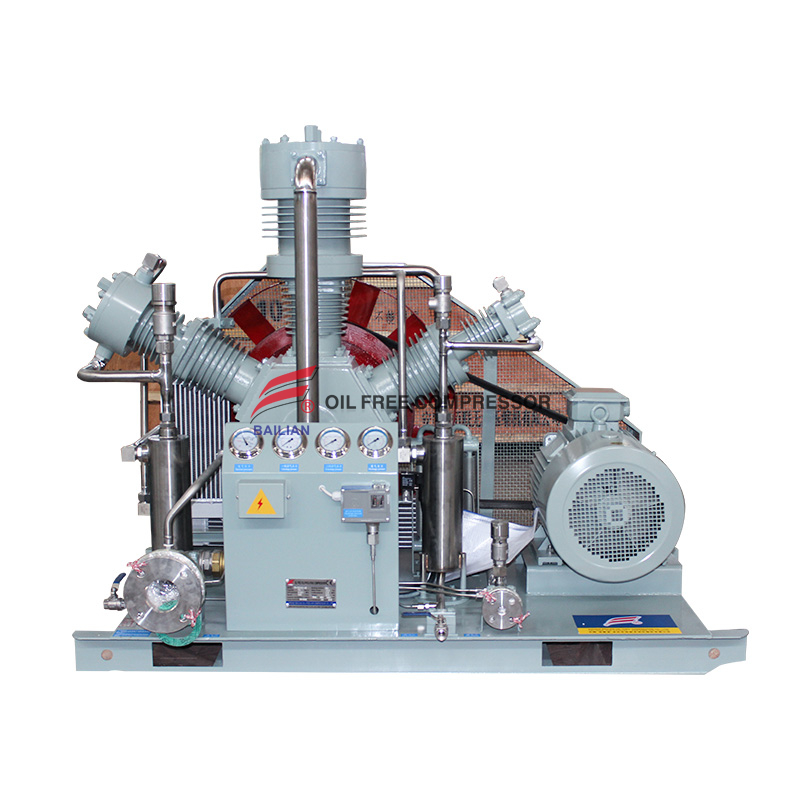
Different industries require vastly different pressure profiles. Food and beverage applications typically demand 15 bar to 25 bar. Facilities use this range for liquefaction and dry ice production. These steady-state requirements focus on consistent output. Zero oil contamination is an absolute necessity here. Any hydrocarbon presence ruins entire production batches.
Enhanced Oil Recovery (EOR) demands much higher parameters. Operators typically require 100 bar to 150+ bar. You must handle variable flow rates constantly. EOR relies on high-pressure supercritical injection to extract crude oil. The equipment must adapt to changing geological backpressures. Flexibility and durability determine success in these harsh environments.
Carbon Capture, Utilization, and Storage (CCUS) pushes limits further. Pipeline transport requires 100 bar to 200+ bar. Dense-phase transport minimizes required pipeline diameters. It maximizes overall transport efficiency across long distances. Keeping the fluid in a dense, supercritical state prevents two-phase flow issues. Two-phase flow causes severe pipeline vibration and mechanical fatigue.
Chemical synthesis requires extreme operational duty. Urea production often demands 140 bar to 200 bar. These processes run continuously without frequent stops. They highlight the necessity for ultra-high-pressure reciprocating systems. Severe-duty cycles require massive foundational support and advanced metallurgy. You cannot cut corners on equipment serving chemical synthesis plants.
Table 1: Standard Pressure Ranges for CO2 Applications
| Industrial Application | Typical Pressure Range | Primary Phase State | Key Requirement |
|---|---|---|---|
| Food & Beverage (Dry Ice) | 15 - 25 bar | Gas / Liquid | Absolute zero oil contamination |
| Enhanced Oil Recovery (EOR) | 100 - 150+ bar | Supercritical | Variable flow rate handling |
| CCUS & Pipeline Transport | 100 - 200+ bar | Dense Phase / Supercritical | Continuous base-load operation |
| Chemical Synthesis (Urea) | 140 - 200 bar | Supercritical | Severe-duty continuous cycle |
Centrifugal compressors excel in specific scenarios. They are best suited for high-volume, continuous base-load operations. Massive CCUS projects and large-scale pipeline transport rely on them heavily. However, they face distinct limitations. They struggle in extreme high-pressure, low-flow scenarios. Aerodynamic surging occurs when flow drops too low. You must match them carefully to your expected mass flow rates.
Reciprocating compressors serve as the industry standard for high pressure. They handle lower-volume applications exceptionally well. These machines manage the immense mechanical stress of extreme compression ratios. Positive displacement technology forces the gas into smaller volumes effectively. They do not suffer from aerodynamic surging. They remain the go-to choice for urea production and deep geological injection.
Integrally geared compressors offer another excellent alternative. You should evaluate them for multi-stage processes. They provide optimal intercooling between distinct compression stages. Effective intercooling manages overall power consumption brilliantly. Each pinion operates at its ideal aerodynamic speed. This flexibility improves overall mechanical efficiency across varied pressure ratios.
You must also choose between oil-free and lubricated designs. Lubricated machines work well for basic industrial transport. However, high-purity applications enforce a strict cutoff. An oil free carbon dioxide compressor transitions from a luxury to a mandatory compliance requirement. FDA regulations demand zero hydrocarbons in food processing. Chemical plants require them to protect highly sensitive catalysts from poisoning.
Evaluating equipment requires a methodical approach. You must look past basic marketing claims. Focus on tangible engineering specifications to ensure reliability. We recommend analyzing four distinct technical criteria before making any procurement decisions.
Testing and validation dictate project success. You must require rigorous mechanical running tests. Insist on API 617 or API 618 standard compliance. Vendors must use actual carbon dioxide or a thermodynamically equivalent test gas. Never accept basic air-test data. Air behaves completely differently under pressure. An air test provides zero guarantee of actual field performance.
Footprint and modularity require careful assessment. You must evaluate integration risks into existing plant infrastructure. Skidded, plug-and-play systems offer faster installation times. They minimize expensive on-site labor. Field-erected heavy machinery takes months to align properly. Choose the configuration matching your facility layout and timeline constraints.
Lifecycle maintenance demands transparent planning. Analyze the required maintenance intervals for all wear parts. Valves, rider rings, and seals degrade over time. Request transparent long-term maintenance cost models spanning 10 to 15 years. You need to know exactly when major overhauls will occur. Unexpected downtime destroys facility profitability rapidly.
Next steps involve gathering precise data. Define the critical metrics required for your vendor RFQ. You need exact inlet temperatures and inlet pressures. Detail the complete gas composition, including trace impurities. Specify the exact required discharge pressure. Finally, provide your maximum and minimum mass flow rates. Accurate data guarantees an accurate engineering proposal.
Specifying equipment for this gas is never a generic procurement task. It requires precise alignment between complex phase behaviors and robust mechanical designs. You must understand exactly how the fluid acts at your target parameters. Overlooking thermodynamics leads to rapid mechanical failures.
We advise decision-makers to prioritize transparent vendors. Look for partners who openly discuss sealing limitations and corrosion mitigation. Avoid vendors making blanket efficiency promises without engineering proof. Real expertise shows in detailed mechanical solutions, not just polished brochures.
You should immediately audit your required mass flow and purity standards. Determine whether a centrifugal unit or a reciprocating oil-free unit fits best. Use these baseline metrics to structure a highly detailed RFQ. Careful front-end engineering guarantees decades of reliable operation.
A: Typically around 5.1 bar (at -56.6°C), but industrial liquefaction usually occurs between 15 and 20 bar at roughly -30°C to -20°C for optimal energy efficiency.
A: It involves compressing the gas past its critical point (73.8 bar) where it becomes a supercritical fluid, experiencing drastic density fluctuations that can cause severe aerodynamic instability or mechanical vibration in the compressor.
A: Whenever downstream processes are intolerant to hydrocarbon contamination—primarily in food and beverage production, dry ice manufacturing, and sensitive chemical synthesis where oil could poison a catalyst.